Wednesday, April 29, 2009

Elmore James - The King of the Slide Guitar


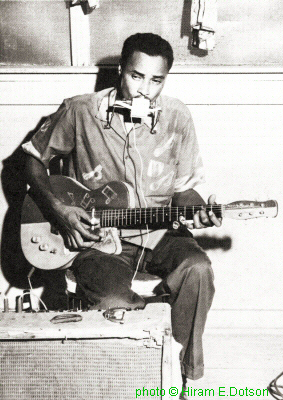
Elmore James (January 27, 1918 – May 24, 1963) was an American blues guitarist, singer, song writer and band leader. He was known as "The King of the Slide Guitar" and had a unique guitar style, noted for his use of loud amplification and his stirring voice.James was born Elmore Brooks in the old Richland community in Holmes County, Mississippi (not to be confused with two other locations of the same name in Mississippi, one in Humphreys County and the other in Rankin County). He was the illegitimate son of 15-year-old Leola Brooks, a field hand. His father was probably Joe Willie "Frost" James, who moved in with Leola, and so Elmore took this as his surname. His parents adopted an orphaned boy, Robert Holston, at some point.
Elmore began making music at age 12 using a simple one-string instrument ('diddley bow' or 'jitterbug') strung up on a shack wall. As a teen he was playing at local dances under the names "Cleanhead" and "Joe Willie James."
Other well-known musicians of that time with whom he played included the "second"' Sonny Boy Williamson and the legendary Robert Johnson. (There is a dispute as to whether Robert Johnson or Elmore wrote James's trademark song, "Dust My Broom".[1]. Elmore was still under 20 when Johnson had recorded his version of the song.) Although Johnson died in 1938, James (like many other musicians) was strongly influenced by him, and also by Kokomo Arnold and Tampa Red. Elmore recorded several of Tampa Red's songs, and even inherited from his band two of his famous "Broomdusters", 'Little' Johnny Jones (piano) and Odie Payne (drums).
An important side to Elmore's character which may have hastened his demise was his lifelong taste for, and manufacture of, moonshine whiskey, to which he was introduced at an early age. Alcohol killed his bandmates and friends Willie Love and Johnny Jones at an early age, and probably others too. His regular rhythm guitarist Homesick James maintained his longevity was due to his not partaking of the heavy drinking sessions after — and often during — gigs, a refusal that was unpopular with the rest of the band. Elmore was also reportedly an extremely fast driver who also loved hunting with guns and dogs down in Mississippi, whence he would head off for protracted periods.
During World War II James joined the United States Navy, was promoted to coxswain and took part in the invasion of Guam against the Japanese. Upon his discharge, Elmore returned to central Mississippi and eventually settled in Canton with his adopted brother Robert Holston, it was at this time he learned that he had a serious heart condition. Working in Robert's electrical shop he devised his unique electric sound, using parts from the shop and an unusual placement of two D'Armond pick ups.[1] He began recording with Trumpet Records in nearby Jackson in January 1951, first as sideman to the second Sonny Boy Williamson and also to their mutual friend Wille Love and possibly others, then debuting as a session leader in August with "Dust My Broom". It was a surprise R&B hit in 1952 and turned James into a star. He then broke his contract with Trumpet Records to sign up with the Bihari Brothers through Ike Turner (who played guitar and piano on a couple of his early Bihari recordings). James' "I Believe" was another hit a year later. During the 1950s he recorded for the Bihari Brothers' Flair Records, Meteor Records and Modern Records labels, as well as for Chess Records and Mel London's Chief Records for whom "It Hurts Me Too" was a hit. His backing musicians were known as the Broomdusters. In 1959 he began recording what are perhaps his best sides for Bobby Robinson's Fire Records label. These include "The Sky Is Crying" (credited to Elmo James and His Broomdusters), "My Bleeding Heart", "Stranger Blues", "Look On Yonder Wall", "Done Somebody Wrong", and "Shake Your Moneymaker", all of which are among the most famous of blues recordings.James played a wide variety of blues (which often crossed over into other styles of music) similar to that of Muddy Waters, Howlin' Wolf and some of B. B. King's work, but distinguished by the powerful sound coming from a modified hollow-bodied traditional acoustic guitar. He most often played using a slide, but on several recordings he plays without. His voice and style was as instantly recognizable as B. B.'s, Muddy's and Wolf's and, until he fell afoul of the Chicago union, he and his Broomdusters were as popular in the Chicago clubs as any of these musicians' bands. Muddy Waters took the Belgian blues fan (Georges Adins) to see Elmore play in Chicago in 1959, Adins recalled,
"Elmore will always remain the most exciting, dramatic blues singer and guitarist that I've ever had a chance to see perform in the flesh. On our way we listened to him on the radio as Big Bill Hill ... was broadcasting direct from that place. I was burning to see Elmore James and before we even pushed open the door of the club, we could hear Elmore's violent guitar sound. Although the place was overcrowded, we managed to find a seat close to the bandstand and the blues came falling down on me as it had never done before. Watching Elmore sing and play, backed by a solid blues band (Homesick James, J.T. Brown, Boyd Atkins and Sam Cassell) made me feel real fine. Wearing thick glasses, Elmore's face always had an expressive and dramatic look, especially when he was real gone on the slow blues. Singing with a strong and rough voice, he really didn't need a mike. On such slow blues as "I'm Worried - "Make My Dreams Come True" - "It Hurts Me", his voice reached a climax and created a tension that was unmistakably the down and out blues. Notwithstanding that raw voice, Elmore sang his blues with a particular feeling, an emotion and depth that showed his country background. His singing was... fed, reinforced by his own guitar accompaniment which was as rough, violent and expressive as was his voice. Using the bottleneck technique most of the time, Elmore really let his guitar sound as I had never heard a guitar sound before. You just couldn't sit still! You had to move..."
Most electric slide guitar players will admit to the massive influence of James' style.[citation needed] He was also a major influence on successful blues guitarists as Homesick James (Elmore's older cousin who was a member of Elmore's band The Broomdusters since 1957 and featured on many of his recordings), John Littlejohn, Hound Dog Taylor, J.B. Hutto and many others. He also influenced many rock guitarists such as The Rolling Stones' Brian Jones and Fleetwood Mac's Jeremy Spencer.Elmore James' songs "Done Somebody Wrong" and "One Way Out" were covered by The Allman Brothers Band, who cited him as a major influence. James was also covered by blues-rock band Stevie Ray Vaughan and Double Trouble many times in concert. The most famous of these covers is one that came by an indirect route: James' fellow bluesman Albert King recorded a cover of "The Sky Is Crying", and Stevie Ray Vaughan copied King's version of the song. That song was also covered by George Thorogood on his second album, Move It On Over and by Eric Clapton .Perhaps the most famous guitarist who admired Elmore James was Jimi Hendrix. Early in Hendrix's career, he styled himself variously as 'Maurice James' and subsequently as 'Jimmy James'. This, according to former band mate and recording partner Lonnie Youngblood, was a tribute to Elmore James.
Elmore James died of his third heart attack in Chicago, Illinois in 1963, just prior to a tour of Europe with that year's American Folk Blues Festival. He is buried in the Newport Baptist Church Cemetery, Ebenezer, Holmes County, Mississippi.

Tuesday, April 7, 2009

Juke Boy Bonner


Weldon H. Philip Bonner, better known as Juke Boy Bonner (22 March 1932 — 29 June 1978[1]) was an American blues singer, harmonica player, and guitarist. He was influenced by Lightnin' Hopkins, Jimmy Reed, and Slim Harpo. He described the bleak prospects of black urban existence in songs like "Life is a Nightmare", "Struggle Here in Houston" and "Going Back to the Country", accompanying himself on guitar, harmonica and drums in the self sufficient one-man band mode of Joe Hill Louis and Dr. Ross.[2]Born in Bellville, Texas, Bonner wp<

as one of nine children; his parents died while he was very young, and he was raised by a neighbour's family, and later, he moved in with his older sister in 1945. At the age of twelve he taught himself the guitar.[1] He gained the nickname "Juke Boy" as a youth, as he frequently sang in local bars accompanied by the juke box. Starting a musical career as teenager, he won the first prize at local disc jockey Trummie Cain's weekly talent show at the Lincoln Theater in Houston, Texas in 1948. Through this he secured a 15 minute radio slot on a show operated by record retailer Henry Atlas. After having three children with his wife, she left him to look after the children by himself.

Between 1954 and 1957 he recorded several singles for the Oakland, California based Irma record label, but not all were released at the time. In 1960 he recorded again, this time for the Goldband Records, Storyville Records, and Jan & Dill Records labels. In 1963 he was diagnosed with a large stomach ulcer, and had to have almost half of his stomach removed in surgery. The shock of this operation, plus the social climate of the times (which included civil rights riots and the assassination of President John F. Kennedy) led Bonner to begin writing poetry, some of which was published in the Forward Times weekly newspaper. Recovering from surgery, Bonner worked as an RCA record distributor in Houston. Once his strength returned he began playing gigs again in the local area.

In 1967 Bonner recorded his first album for the Flyright label. Chris Strachwitz's Arhoolie label released two albums, I'm Going Back to The Country (1968) and The Struggle (1969) (Arhoolie would later issue some of Bonner's unreleased 1967-1974 recordings on 2003's Ghetto Poet). Bonner recorded mostly original song material through his recording career. He was a guest at the Ann Arbor Blues Festival, the American Folk Blues Festival, and the Montreux Blues and Rock Festival. In 1972 he released an LP for Sonet Records, and in 1975 another one for the Houston based Home Cooking Records label. However, Bonner was not able to support himself from his music due to little demand for his work. Although he would continue to play and record sporadically, he had no choice but to take a minimum wage job at a chicken processing plant in Houston.[1]

Bonner died in his apartment in 1978, aged forty-six, of cirrhosis of the liver.
Juke Boy Bonner mp3's

Thursday, April 2, 2009

Willie Brown - Delta Bluesman


Willie Brown (August 6, 1900 – December 30, 1952[1]) was an American delta blues guitarist and singer.Born in Clarksdale, Mississippi,[1] Brown played with such notables as Charley Patton, Son House, and Robert Johnson. He was not known to be a self-promoting frontman, preferring to "second" (accompany) other musicians. Little is known for certain of the man whom Robert Johnson called "my friend-boy, Willie Brown" (in his prophetic "Cross Road Blues") and whom Johnson indicated should be notified in event of his death. Brown is heard with Patton on the Paramount label sessions of 1930, playing "M & O Blues," and "Future Blues."[1] Apart from playing with Son House and Charlie Patton it has also been said that he played with artists such as Luke Thomson and Thomas "Clubfoot" Coles. At least four other songs he recorded for Paramount have never been found.
"Rowdy Blues", a 1929 song credited to Kid Bailey, is disputed to have Brown on backup, or Brown himself using the name of Kid Bailey. Willie Brown does his song "Future Blues" on the album Son House & The Great Delta Blues Singers (1994), recorded between 1928 and 1930, on the Document Records label.
David Evans has reconstructed the early biography of a Willie Brown living in Drew, Mississippi, until 1929. He was married by 1911 to a proficient guitarist named Josie Mills. He is recalled as singing and playing guitar with Charley Patton and others in the neighbourhood of Drew.[2] Informants with conflicting memories led Gayle Dean Wardlow and Steve Calt to conclude that this was a different Willie Brown.[3] Evans rejects this, believing that the singing and guitar style of the 1931 recordings is clearly in the tradition of other performers from Drew such as Charley Patton, Tommy Johnson, Kid Bailey, Howling Wolf and artists recorded non-commercially.
Alan Lomax added further confusion in 1993, suggesting that the William Brown he recorded in Arkansas in 1942 was the same man as the Paramount artist.[4] The recording was for a joint project between Fisk University and the Library of Congress documenting the music of Coahoma County, Mississippi in 1941 and 1942. Writing over fifty years later, Lomax forgot that he had actually recorded Willie the previous summer with Son House, Fiddlin' Joe Martin and Leroy Williams. Brown played second guitar on three performances by the whole band, and recorded one solo, "Make Me A Pallet On The Floor".The later biography is clear. Willie Brown, the Paramount artist, lived in Robinsonville, Mississippi from 1929 and moved to Lake Cormorant, Mississippi by 1935. He performed occasionally with Charley Patton, and continually with Son House until his death. After this, House ceased performing until his "rediscovery" in 1964.

Brown died in Tunica, Mississippi in 1952 at the age of 52.

Sunday, March 15, 2009

LIL Son Jackson - East Texas Country Bluesman


* Born: August 16, 1915, Tyler, TX
* Died: May 30, 1976, Dallas, TX
* Active: '40s, '50s, '60s
* Genres: Blues
* Instrument: Vocals, Guitar
* Representative Albums: "Lil' Son Jackson," "Blues Come to Texas," "Rockin' and Rollin', Vol. 1: 1948-1950"

Biography
Lil' Son Jackson was a stylistic throwback from the moment he first turned up during the immediate postwar era. Born Melvin Jackson, he was a Texas country bluesman of the highest order whose rustic approach appealed wholeheartedly to the early-'50s blues marketplace. His dad loved blues, while his mother played gospel guitar. Their son's initial experience came with a spiritual aggregation called the Blue Eagle Four. A mechanic by trade, he served in the Army during World War II before giving the idea of being a professional blues musician a shot. In 1946, he shipped off a demo to Bill Quinn, who owned a Houston diskery called Gold Star Records. Quinn was suitably impressed, inking Jackson and enjoying a national R&B hit, "Freedom Train Blues," in 1948 for his modest investment. It would prove Jackson's only national hit, although his 1950-1954 output for Imperial Records must have sold consistently, judging from how many sides the L.A. firm issued by the Texas guitarist. Jackson's best Imperial work was recorded solo. Later attempts to squeeze his style into a small band format (his idea, apparently) tended to emphasize his timing eccentricities. His "Rockin' and Rollin'," cut in December of 1950, became better known through a raft of subsequent covers as "Rock Me Baby." He gave up the blues during the mid-'50s after an auto wreck, resuming work as a mechanic. Arhoolie Records boss Chris Strachwitz convinced Jackson to cut an album in 1960.Jackson had something of a second career when Chris Strachwitz of Arhoolie located him during the summer of 1960 in Dallas and convinced Jackson to try recording once again. From these sessions came nearly two dozen songs in the traditional Texas blues style that seems to be an offshoot from the music of the Mississippi delta region. Among the tracks included in this reissue are 'Blues Come to Texas,' 'West Dallas Blues,' 'I Walked from Dallas,' and, in something of a stretch, 'Cairo Blues,' a particularly fine performance. This is a fine collection.” Jackson died May 30, 1976, in Dallas, TX, from cancer. ~ Bill Dahl, All Music Guide
Answers.com

Tuesday, February 24, 2009

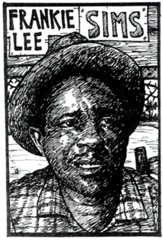
Frankie Lee Sims - Texas Country Bluesman


A traditionalist who was a staunch member of the Texas country blues movement of the late '40s and early '50s (along with the likes of his cousin Lightnin' Hopkins, Lil' Son Jackson, and Smokey Hogg), guitarist Frankie Lee Sims developed a twangy, ringing electric guitar style that was irresistible on fast numbers and stung hard on the downbeat stuff.

Sims picked up a guitar when he was 12 years old. By then, he had left his native New Orleans for Marshall, TX. After World War II ended, he played local dances and clubs around Dallas and crossed paths with T-Bone Walker. Sims cut his first 78s for Herb Rippa's Blue Bonnet Records in 1948 in Dallas, but didn't taste anything resembling regional success until 1953, when his bouncy "Lucy Mae Blues" did well down south.

The guitarist recorded fairly prolifically for Los Angeles-based Specialty into 1954, then switched to Johnny Vincent's Ace label (and its Vin subsidiary) in 1957 to cut the mighty rockers "Walking with Frankie" and "She Likes to Boogie Real Low," both of which pounded harder than a ballpeen hammer.

Sims claimed to play guitar on King Curtis's 1962 instrumental hit "Soul Twist" for Bobby Robinson's Enjoy label, but that seems unlikely. It is assumed that he recorded for Robinson in late 1960 (the battered contents of three long-lost acetates emerged in 1985 on the British Krazy Kat label).

Sims mostly missed out on the folk-blues revival of the early '60s that his cousin Lightnin' Hopkins cashed in on handily. When he died at age 53 in Dallas of pneumonia, Sims was reportedly in trouble with the law due to a shooting incident and had been dogged by drinking problems. ~ Bill Dahl, All Music Guide. Similar Artists:
Andrew "Smokey" Hogg, Melvin "Lil' Son" Jackson, Forest City Joe Influenced By:
Lightnin' Hopkins, T-Bone Walker, Blind Lemon Jefferson, John Lee Hooker

* Born: April 30, 1917, New Orleans, LA
* Died: May 10, 1970, Dallas, TX
* Active: '40s, '50s, '60s
* Genres: Blues
* Instrument: Vocals, Guitar
* Representative Albums: "Lucy Mae Blues," "Walking with Frankie"
* Representative Songs: "Lucy Mae Blues," "She Likes to Boogie Real Low," "Walkin' With Frankie"

Tuesday, February 10, 2009

Blind Lemon Jefferson - Father of Texas Blues


Blind" Lemon Jefferson (September 24, 1893 – December 1929) was an influential blues singer and guitarist from Texas. He was one of the most popular blues singers of the 1920s, and has been titled "Father of the Texas Blues."His musical style was individualistic, and Jefferson's singing and self-accompaniment were distinctive as a result of his high-pitched voice and originality on the guitar.[6] He was not influential on some younger blues singers of his generation, as they did not seek to imitate him as they did other commercially successful artists.[7] However, later blues and rock and roll musicians attempted to imitate both his songs and his musical style.Jefferson was born blind near Coutchman, Texas in Freestone County, near present-day Wortham, Texas.[3] Jefferson was one of eight children born to sharecroppers Alex and Clarissa Jefferson.[3] Disputes regarding his exact birth date derive from contradictory census records and draft registration records. By 1900, the family was farming southeast of Streetman, Texas, and Lemon Jefferson's birth date is indicated as September 1893 in the 1900 census.Jefferson began playing the guitar in his early teens, and soon after he began performing at picnics and parties.[3] He also became a street musician, playing in East Texas towns in front of barbershops and on corners.By the early 1910s, Jefferson began traveling frequently to Dallas, where he met and played with fellow blues musician Leadbelly.[13] In Dallas, Jefferson was one of the earliest and most prominent figures in the blues movement developing in Dallas' Deep Ellum area. Jefferson likely moved to Deep Ellum in a more permanent fashion by 1917, where he met Aaron Thibeaux Walker, also known as T-Bone Walker.[13] Jefferson taught Walker the basics of blues guitar, in exchange for Walker's occasional services as a guide.in December 1925 or January 1926, he was taken to Chicago, Illinois, to record his first tracks. Uncharacteristically, Jefferson's first two recordings from this session were gospel songs ("I Want to be like Jesus in my Heart" and "All I Want is that Pure Religion"), released under the name Deacon L. J. Bates. This led to a second recording session in March 1926. His first releases under his own name, "Booster Blues" and "Dry Southern Blues," were hits; this led to the release of the other two songs from that session, "Got the Blues" and "Long Lonesome Blues," which became a runaway success, with sales in six figures. He recorded about 100 tracks between 1926 and 1929; 43 records were issued.Jefferson is known to have done an unusual amount of traveling for the time in the American South, which is reflected in the difficulty of pigeonholing his music into one regional category.Jefferson had an intricate and fast style of guitar playing and a particularly high-pitched voice. He was a founder of the Texas blues sound and an important influence on other blues singers and guitarists, including Lead Belly and Lightnin' Hopkins.
He sticks to no musical conventions, varying his riffs and rhythm and singing complex and expressive lyrics in a manner exceptional at the time for a "simple country blues singer."Jefferson was reputedly unhappy with his royalties (although Williams said that Jefferson had a bank account containing as much as $1500). In 1927, when Williams moved to OKeh Records, he took Jefferson with him, and OKeh quickly recorded and released Jefferson's "Matchbox Blues" backed with "Black Snake Moan," which was to be his only OKeh recording, probably because of contractual obligations with Paramount. Jefferson's two songs released on Okeh have considerably better sound quality than on his Paramount records at the time. When he had returned to Paramount a few months later, "Matchbox Blues" had already become such a hit that Paramount re-recorded and released two new versions, under producer Arthur Laibly.In 1927, Jefferson recorded another of his now classic songs, the haunting "See That My Grave Is Kept Clean" (once again using the pseudonym Deacon L. J. Bates) along with two other uncharacteristically spiritual songs, "He Arose from the Dead" and "Where Shall I Be." Of the three, "See That My Grave Is Kept Clean" became such a big hit that it was re-recorded and re-released in 1928. Jefferson died in Chicago in December 1929. The cause of death is unknown, and though rumors swirled that a jealous lover poisoned his coffee, a more likely scenario is that he died due to a heart attack after being disoriented during a snowstorm (another scenario is that he froze to death). The book "Tolbert's Texas" claims that he was killed while being robbed of a large royalty cash payment by a guide taking him to Union Station to catch a train home to Texas. Paramount Records paid for the return of his body to Texas by train, accompanied by pianist Will Ezell. Jefferson was buried at Wortham Negro Cemetery (now Wortham Black Cemetery). Far from his grave being kept clean, it was unmarked until 1967, when a Texas Historical Marker was erected in the general area of his plot, the precise location being unknown. By 1996, the cemetery and marker were in poor condition, but a new granite headstone was erected in 1997. In 2007 the cemetery's name was changed to Blind Lemon Memorial Cemetery . Blind Lemon Jefferson is the featured musician on a State of Texas license plate. B. B. King has always maintained that Jefferson was a huge influence on his singing and guitar playing. The Rock and Roll Hall of Fame listed one song by Blind Lemon Jefferson of the 500 songs that shaped rock and roll.