Paul 'Wine' Jones, blues musician, born July 1 1946; died October 9 2005 .Jones of Belzoni, Mississippi, a small town with a rich blues heritage in the heart of the delta, is a professional welder. He lived with his wife Bessie Mae in a house he purchased with the sweat of his brow. Before becoming a welder, Jones worked in a Delta cotton gin; before that, like many of his Delta neighbors, he worked on a farm. And throughout his adult life, Paul Jones has been a bluesman, known and admired by a number of his fellow Delta musicians but seldom venturing far from home. His style is deeply rooted in the rural blues of the delta, but so distinctly original and idiosyncratic that his sound will not easily be mistaken for that of any other artist. Rock-solid bass-string drones, expansively sonic guitar textures, a seasoning of wah-wah riffs, and a voice that can sound vinegary, molasses-like, or simply, urgently passionate, as the song demands - these are some of the qualities that make Paul Jones a unique and formidable talent.
"I'm from Flora, Mississippi," says Paul, "a little town about eighteen miles from Jackson. My daddy was a guitar player years ago, when I was a little boy. When he used to come home from working on the farm, we'd have frolics, and after he played awhile he'd rest his guitar on the floor and I'd get on it. It came natural to me; nobody taught me, I was just born to it. I started in playing, and by the time I was about thirteen, people would come by and want to take me with 'em to play somewhere out in the country. Before my dad died, four of the children had taken up the guitar, including my sister Jo Ann. She stopped, but I didn't ever stop." Among Paul's other siblings was Casey Jones, who now lives in Chicago where he is one of the most in-demand drummers for blues gigs and recording sessions.
Paul is old enough to have heard some of the Delta's most celebrated blues stylists as a youth, young enough to be a post - B. B. King "modernist" if he'd chosen to go that way. Instead he developed a style that is unabashedly "country" and "in the tradition" but with modern shadings - that wah-wah pedal - and a dexterous manner of subsuming rhythm and lead functions in to a guitar style with the momentum and unpredictability of a runaway steamroller. His first album, Mule, revealed Jones as a sturdy practitioner of the droning, timeless blues played by so many Mississippi musicians, from Kimbrough and Burnside to John Lee Hooker. Cheerfully accentuating his guitar lines with a wah-wah pedal, and tightly accompanied by the incomparable drummer Sam Carr and guitarists Big Jack Johnson and Kenny Brown, Jones turned whiskery old numbers like Diggin' my Potatoes into what his producer Robert Palmer called "progressive country blues".
By the time Jones came to make his second album, Pucker Up Buttercup, in 1999, Fat Possum was less disposed to let its plain old bluesmen make plain old blues records. Matthew Johnson, the label's owner, was no doubt encouraged by the response to projects like A Ass Pocket Of Whiskey, Burnside's 1996 collaboration with the Jon Spencer Blues Explosion - the more so, probably, in that it was generally hated by hardline blues fans, a constituency Johnson says he has no interest in pleasing.
Such listeners were hardly like to be assuaged by Pucker Up Buttercup, with its distorted guitar playing, and when presented with a closing track titled Guess I Done Fucked It All Up were all too likely to agree. Jones did not record again.
Saturday, August 22, 2009


Tuesday, August 4, 2009
T-Model Ford "The Taildragger"
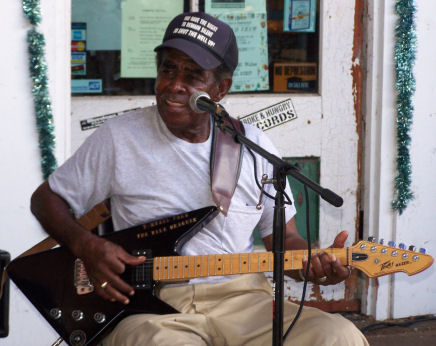
James Lewis Carter Ford (born in Forest, Mississippi, 1920) is an American blues musician better known by his stage name, T-Model Ford. Unable to remember his exact date of birth, he began his musical career in his early seventies and has continuously recorded for the Fat Possum Records label.
His musical style melds traditional Chicago blues and juke joint blues styles with the rawness of Delta blues and the rebellious attitude of 1970s-style punk. Alternately known as "The Taildragger", Ford, in reference to his age, has been known to tell studio musicians, "T-Model Ford is going to remember you sorry fuckers how it's done. "James Ford grew up working various blue collar jobs as early as his preteen years, such as plowing fields, working at a sawmill, and later in life becoming a lumber company foreman and then a truck driver. However, when reflecting on this time in his life, Ford recalls, "I could really stomp some ass back then. I was a sure-enough-dangerous man. Currently, Ford resides in Greenville, Mississippi.his birth was somewhere between 1921 and 1925. According to his half-sister (still alive in Tennessee), he was born in 1922.According to Ford, he is not retiring. "No way ... only the good lord knows when I'm gonna stop." To that end, Mr Ford has said he has had a dream that he will live to 110. At that rate, he's got over twenty years left.
Thursday, July 2, 2009
Robert Pete Williams

Robert Pete Williams (March 14, 1914 – December 31, 1980) was an American Louisiana blues musician, based in Louisiana. His music characteristically employs unconventional blues tunings and structures, and his songs are often about the time he served in prison. His song "I've Grown So Ugly" has been covered by Captain Beefheart, on his album Safe as Milk (1967), and by The Black Keys, on Rubber Factory (2004).
Williams was born in Zachary, Louisiana to sharecropping parents, and lived around the Baton Rouge area throughout his life.[1] He was discovered in Angola prison, by ethnomusicologists Dr Harry Oster and Richard Allen, where he was serving a life sentence for shooting a man dead in a local club in 1956, an act which he claimed was in self-defense.“...the most avant-garde blues performer ever recorded. No punk rock band has ever matched the jagged, acerbic fury of the riffs Williams played 35 years ago. No rapper has approached his ability to evoke the torment of life in prison or bend language to cast an eerie spell over a chance encounter with a seductive woman.... He had never been recorded when he was discovered in Angola Penitentiary in Louisiana, convicted of murder. Oster and Allen recorded Williams performing several of his songs about life in prison and pleaded for him to be pardoned. The pardon was partially granted in 1959, when Williams was released, although he could not leave Louisiana until he received a full pardon in 1964. By this time, Williams' music had achieved some favorable word-of-mouth reviews, and he played his first concert outside Louisiana at that year's Newport Folk Festival.
Williams went on to tour the United States, and played a number of concerts with Mississippi Fred McDowell. He continued to play concerts and festivals into the late 1970s when his health began to decline.
His most popular recordings included "Prisoner's Talking Blues" and "Pardon Denied Again".Williams has been inducted into the Louisiana Blues Hall of Fame.
Williams died in Rosedale, Louisiana on 31 December 1980, at the age of 66.
Wednesday, June 10, 2009
Rube Lacy
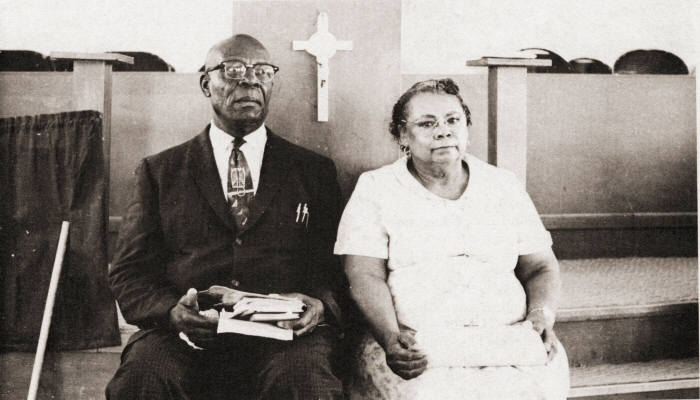
RUBIN ''RUBE'' LACY BIOGRAPHY: (born January 2, 1901, Pelahatchie, Miss.; died c. 1972, Bakersfield, CA)
An important influence on blues great SON HOUSE, Rubin Lacy was part of the Jackson, Mississippi, blues scene in the 1920s -- a scene that also included ISHMAN BRACEY, TOMMY JOHNSON, and CHARLIE MCCOY. LaCY recorded only two sides during his career as a bluesman, but his chiseled vocals and rummaging guitar style played a role in the early development of Delta blues.
Lacy was raised by his grandfather, a preacher. After learning how to play guitar, he left home and worked Mississippi juke joints. He drifted as far north as Illinois in the mid-1920s before returning to the Jackson area, where he frequently performed with the above-mentioned blues musicians and the popular Chatmon family. His two recordings --- ''Mississippi Jail House Groan'' and ''Ham Hound Crave'' --- were cut for Paramount in 1928, although he reputedly played on a number of other recordings made by Mississippi bluesmen. Sometime around 1932 Lacy quit the blues and became a Baptist minister. For the next two decades he preached in Mississippi churches. In the late 1950s Lacy moved to Los Angeles, and later settled in Bakersfield, where he died in or around 1972. -- by Robert Santelli
Tuesday, May 26, 2009
Tommy Johnson

Tommy Johnson (1896 – November 1, 1956) was an influential American delta blues musician who recorded in the late 1920s, known for his eerie falsetto voice and intricate guitar playing.
Johnson was born near Terry, Mississippi, and moved around 1910 to Crystal Springs where he lived for most of his life. He learned to play the guitar and, by 1914, was supplementing his income by playing at local parties with his brothers Mager and LeDell. In 1916 he married and moved to Webb Jennings' Plantation near Drew, Mississippi, close to the Dockery Plantation. There he met other musicians including Charlie Patton and Willie Brown.By 1920 he had become an alcoholic and itinerant musician, based in Crystal Springs but travelling widely around the South, sometimes accompanied by Papa Charlie McCoy. In 1928 he made his first recordings with McCoy for Victor Records. The recordings included "Canned Heat Blues", in which he sang of drinking methanol from the cooking fuel Sterno. The song features the refrain "canned heat, mama, sure, Lord, killing me." The blues group Canned Heat took their name from this song. Johnson's "Big Road Blues" inspired Canned Heat's song, "On the Road Again". A significantly different version of the song appears as "Canned Heat" on the Big Road Blues album by K. C. Douglas.
He recorded two further sessions, in August 1928 and for Paramount Records in December 1929. He did not record again, mistakenly believing that he had signed away his right to record . This resulted on a legal settlement with The Mississippi Sheiks who had used Johnson's 'Big Road Blues' melody in their enormously successful "[Stop and Listen]". Johnson was party to the copyright settlement, but was too drunk at the time to understand what he had signed to.
Johnson's recordings established him as the premier Delta blues vocalist of his day, with a powerful voice that could go from a growl to a falsetto. He was also an accomplished guitarist. His style influenced later blues singers such as Robert Nighthawk and Howlin' Wolf, whose song "I Asked for Water (She Brought Me Gasoline)" was based on Johnson's "Cool Water Blues". He was a talented composer, blending fragments of folk poetry and personalized lyrics into set guitar accompaniments to craft striking blues compositions such as "Maggie Campbell.To enhance his fame, Johnson cultivated a sinister persona. According to his brother LeDell, he claimed to have sold his soul to the devil in exchange for his mastery of the guitar. This story was later also associated with Robert Johnson, to whom he was unrelated. Tommy Johnson also played tricks with his guitar, playing it between his legs and behind his head, and throwing it in the air while playing.
Johnson remained a popular performer in the Jackson area through the 1930s and 1940s, sometimes performing with Ishman Bracey. He was highly influential on other performers, partly because he was willing to teach his style and his repertoire.He died of a heart attack after playing a party in 1956. He is buried in the Warm Springs Methodist Church Cemetery outside of Crystal Springs, Mississippi. In 2001 a headstone was commissioned through the Mt. Zion Memorial Fund, a Mississippi non-profit corporation, by the family of Tommy Johnson and paid for by musician Bonnie Raitt.
Thursday, May 7, 2009
J. B. Hutto - the epitome of intense electrified urban Chicago blues

J. B. Hutto (April 26, 1926 - June 12, 1983[1]) was an American blues musician, born Joseph Benjamin Hutto. Hutto was heavily influenced by legendary bluesman Elmore James, and became known for his slide guitar work and declamatory style of singing. He was inducted into the Blues Hall of Fame two years after his death.Hutto was born in Blackville, South Carolina, the fifth of seven children. His family moved to Augusta, Georgia, when Hutto was three years old. His father, Calvin, was a preacher, and Hutto, along with his three brothers and three sisters, formed a gospel group called The Golden Crowns, singing in local churches. Hutto's father died in 1949, and the family relocated to Chicago. Hutto served as a draftee in the Korean War in the early 1950s, driving trucks in combat zones.
In Chicago, Hutto took up the drums and played with Johnny Ferguson and his Twisters. He also tried the piano before settling on the guitar, and playing on the streets with percussionist Eddie 'Porkchop' Hines. After adding Joe Custom on second guitar they started playing club gigs, and harmonica player George Mayweather joined after sitting in with the band. Hutto named his band The Hawks, after the wind that blows in Chicago. A recording session in 1954 resulted in the release of two singles on the Chance label, and a second session later the same year, with the band supplemented by pianist Johnny Jones, produced a third.
Later in the 1950s Hutto became disenchanted with music and gave it up to work as an undertaker after a woman broke his guitar over her husband's head one night.[6] He returned to music in the mid 1960s with a new version of the Hawks featuring Herman Hassell on bass and Frank Kirkland on drums.[7] His recording career resumed with, first, a session for Vanguard Records released on the compilation album Chicago/the Blues/Today! Vol. 1, and then albums for Testament and Delmark.[8] After Hound Dog Taylor died in 1975, Hutto took over his band the Houserockers for a time, and in the late 1970s he moved to Boston and recruited a new band which he called the New Hawks, with whom he recorded further studio albums for the Varrick label.J.B.'s music remains the epitome of intense electrified urban Chicago blues, J.B.'s music and influence range from Big Bill Broonzy to Muddy Waters. Moreover, J.B.'s boogie and rollicking style draw comparisons to Fats Domino and Bo Diddley.
J.B. did not possess the musical polish that other musicians had, nor did he have the business acumen or experience the popularity of some of his contemporaries. J.B., did possess an instantly recognizable, moving and emotional slide guitar and vocal that could bring a crowded bar room to a halt.Hutto returned to Illinois in the early 1980s, where he was diagnosed with cancer. He died in 1983, at the age of 57, in Harvey, Illinois. He was interred at the Restvale Cemetery, Alsip, Cook County, Illinois.
In 1985 the Blues Foundation inducted Hutto into its Hall of Fame.[10] His nephew, Lil' Ed Williams (of Lil' Ed and the Blues Imperials) has carried on his legacy, playing and singing in a style very close to his uncle.
Friday, May 1, 2009
Charley Patton - Father of Delta Blues
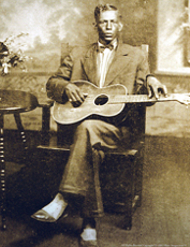
Today is The Birthday of Charlie Patton kown as "Charley Patton" considered the father of Delta Blues.
"Charley Patton (May 1, 1891 – April 28, 1934) is best known as an American Delta blues musician. He is considered by many to be the "Father of Delta Blues" and therefore one of the oldest known figures of American popular music. He is credited with creating an enduring body of American music and personally inspiring just about every Delta blues man (Palmer, 1995). Musicologist Robert Palmer considers him among the most important musicians that America produced in the twentieth century. Many sources, including musical releases and his gravestone,[1] spell his name “Charley” even though the musician himself spelled his name "Charlie."Charlie Patton was one of the first mainstream stars of the Delta blues genre. Patton, who was born in Hinds County, Mississippi near Edwards, lived most of his life in Sunflower County, in the Mississippi Delta. Most sources say he was born in 1891, but there is some debate about this, and the years 1887 and 1894 have also been suggested. In 1900, his family moved 100 miles north to the legendary 10,000-acre Dockery Plantation sawmill and cotton farm near Ruleville, Mississippi. It was here that both John Lee Hooker and Howlin' Wolf fell under the Patton spell. It was also here that Robert Johnson played and was given his first guitar.
At Dockery, Charlie fell under the tutelage of Henry Sloan, who had a new, unusual style of playing music which today would be considered very early blues. Charlie followed Henry Sloan around, and, by the time he was about 19, had become an accomplished performer and songwriter in his own right, having already composed "Pony Blues," a seminal song of the era.
Robert Palmer describes Patton as a "jack-of all-trades bluesman" who played "deep blues, white hillbilly songs, nineteenth century ballads, and other varieties of black and white country dance music with equal facility".
He was extremely popular across the Southern United States, and — in contrast to the itinerant wandering of most blues musicians of his time — played scheduled engagements at plantations and taverns. Long before Jimi Hendrix impressed audiences with flashy guitar playing, Patton gained notoriety for his showmanship, often playing with the guitar down on his knees, behind his head, or behind his back. Although Patton was a small man at about 5 foot 5 and 135 pounds, his gravelly voice was rumored to have been loud enough to carry 500 yards without amplification. Patton's gritty bellowing was a major influence on the singing style of his young friend Chester Burnett, who went on to gain fame in Chicago as Howlin' Wolf.Patton's ethnicity is the subject of minor debate. Though he was considered African-American, because of his light complexion there have been rumors that he was Mexican, or possibly a full-blood Cherokee, a theory endorsed by Howlin' Wolf. In actuality, Patton was a mix of white, black, and Cherokee (one of his grandmothers was a full-blooded Cherokee). Patton himself sang in "Down the Dirt Road Blues" of having gone to "the Nation" and "the Territo'" -- meaning the Cherokee Nation portion of the Indian Territory (which became part of the state of Oklahoma in 1907), where a number of Black Indians tried unsuccessfully to claim a place on the tribal rolls and thereby obtain land.
Patton settled in Holly Ridge, Mississippi with his common-law wife and recording partner Bertha Lee in 1933. He died on the Heathman-Dedham plantation near Indianola from heart disease on April 28, 1934 and is buried in Holly Ridge (both towns are located in Sunflower County). A memorial headstone was erected on Patton's grave (the location of which was identified by the cemetery caretaker C. Howard who claimed to have been present at the burial) paid for by musician John Fogerty through the Mt. Zion Memorial Fund in July, 1990."
Subscribe to:
Posts (Atom)