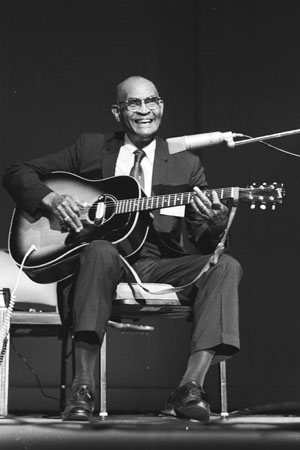
Robert Wilkins (January 16, 1896 – May 26, 1987) was an American blues guitarist and vocalist, of African American and Cherokee descent.Robert Timothy Wilkins was born in Hernando, Mississippi, 21 miles from Memphis.He served in the Army during World War I but returned to Memphis in 1919 to become a professional musician.
Wilkins worked in Memphis during the Roaring Twenties, sharing billing with Furry Lewis, Memphis Minnie (whom he claimed to have tutored), Son House, and other musicians for local shows.
He also organized a jug band to capitalize on the "jug band craze" then in vogue. Though never attaining success comparable to the Memphis Jug Band, Wilkins reinforced his local popularity with a 1927 appearance on a Memphis radio station. Like Sleepy John Estes (and unlike Gus Cannon of Cannon's Jug Stompers) he recorded alone or with a single accompanist. He sometimes performed as Tim Wilkins or as Tim Oliver (his stepfather's name).
His best known songs are "That's No Way To Get Along" (to which he – an ordained minister since the 1930s – had changed the 'unholy' words to a biblical theme and since titled it "The Prodigal Son", covered under that title by The Rolling Stones), "Rolling Stone", and "Old Jim Canan's". His first sessions for the Victor label in 1928 yielded the droning, one-chord "Rolling Stone," whose title, if not structure, later inspired Muddy Waters.Led Zeppelin also wrote "Poor Tom", which was believed to have been influenced by "That's No Way To Get Along".
During the 1920s and 1930s, Robert Wilkins was one of the most popular blues artists associated with Beale Street. In a personal crisis, he turned to the Lord, offering his life in exchange for that of his beloved wife, and never looked back.Alarmed by fighting at a party where he was playing, he deserted secular music and he took up the twin careers of herbalist and minister in the Church of God in Christ in the 1930s, and began playing gospel music with a blues feel.
When the Rolling Stones recorded Wilkins' "Prodigal Son" in the early '60s, blues researchers found Wilkins at home in Memphis, ministering to the congregation at the Lane Avenue Church of God in Christ and performing gospel songs (which bore a striking melodic similarity to Tim Wilkins' blues) at street corner revivals.Made appearances at folk festivals and recording his gospel blues for a new audience. These include the 1964 Newport Folk Festival; his performance of "Prodigal Son" there was included on the Vanguard album Blues at Newport.His distinction was his versatility; he could play ragtime, blues, minstrel songs, and gospel with equal facility.
Wikins died in May 1987 in Memphis, Tennessee, at the age of 91.
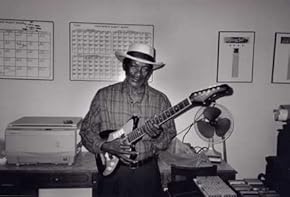
Willie Johnson (March 4, 1923 – February 26, 1995) was an American blues guitarist. He is best known as the principal guitarist in Howlin' Wolf's band from 1948 to 1953. His raucous, distorted guitar playing features on Howlin' Wolf's Memphis recordings of 1951-3, including the 1951 hit "How Many More Years". His early use of distortion marks him out as one of the pioneers of the electric guitar. Willie Lee Johnson was born in Senatobia, Mississippi.
As the guitarist in the first band led by Howlin' Wolf, Johnson appeared on most of Wolf's recordings between 1951 and 1953, providing the slightly jazzy yet raucous guitar sound that was the signature of all of Wolf's Memphis recordings. Johnson also performed and recorded with other blues artists in the Memphis area, including pianist Willie Love, Willie Nix, Junior Parker, Roscoe Gordon, Bobby "Blue" Bland and others.
When Wolf moved to Chicago in around 1953, he could not convince Johnson to join him. Johnson stayed on in Memphis for several years, playing on a number of sessions for Sun Records, including a 1955 collaboration with vocalist Sammy Lewis, "I Feel So Worried", released under the name Sammy Lewis with Willie Johnson. By the time Johnson relocated to Chicago, Wolf had already hired guitarist Hubert Sumlin as a permanent replacement. James Cotton later recalled that Wolf replaced Johnson because of his heavy drinking.
Johnson occasionally performed and recorded with Howlin' Wolf after settling in Chicago, and also played briefly in the band of Muddy Waters, as well as a number of other local Chicago blues musicians, including J. T. Brown, in the late 1950s and early 1960s. He made his living mainly outside of music for the rest of his life, only occasionally sitting in with the bands of his old friends around Chicago.
His final recordings were made for Earwig Records in Chicago in the early 1990s. Willie Johnson died in Chicago on February 21, 1995
Born in 1927 near Lakeland, LA, Louis Overstreet began singing in gospel quartets at an early age. He was working in a turpentine plant in Dequincy, LA, in 1958, however, when he felt the call to become a full-time minister. Blessed with a ferocious, deep singing voice and accompanying himself on electric guitar and bass drum (playing both at once), the Rev. Louis Overstreet, along with a gospel quartet made up of his four sons, took his own brand of street evangelism around Louisiana and to Texas, Alabama, Mississippi, Tennessee, Arizona, Nevada, and California before settling in as the pastor of St. Luke's Powerhouse Church of God in Christ in Phoenix, AZ, in 1961. It was there that Chris Strachwitz of Arhoolie Records recorded Overstreet and his congregation and sons for the 1962 LP Rev. Louis Overstreet. The album was reissued on CD in 1995 with additional tracks recorded at Overstreet's home and a track from a 1963 appearance at the Cabale Coffee House in Berkeley, CA. Overstreet passed away in 1980.
Chester Arthur Burnett (June 10, 1910 – January 10, 1976), better known as Howlin' Wolf, was an influential American blues singer, guitarist and harmonica player.
With a booming voice and looming physical presence, Burnett is commonly ranked among the leading performers in electric blues; musician and critic Cub Koda declared, "no one could match Howlin' Wolf for the singular ability to rock the house down to the foundation while simultaneously scaring its patrons out of its wits. A number of songs written or popularized by Burnett—such as "Smokestack Lightnin'", "Back Door Man", "Killing Floor" and "Spoonful"—have become blues and blues rock standards.
At 6 feet, 6 inches and close to 300 pounds , he was an imposing presence with one of the loudest and most memorable voices of all the "classic" 1950s Chicago blues singers. This rough-edged, slightly fearsome musical style is often contrasted with the less crude but still powerful presentation of his contemporary and professional rival, Muddy Waters - although the two were reportedly not that different in actual personality - to describe the two pillars of the Chicago blues representing the music.
Born in White Station, Mississippi, near West Point, he was named after Chester A. Arthur, the 21st President of the United States, and was nicknamed Big Foot Chester and Bull Cow in his early years because of his massive size. He explained the origin of the name Howlin' Wolf thus: "I got that from my grandfather [John Jones]." He used to tell him stories about the wolves in that part of the country and warn him that if he misbehaved, they would "get him". According to the documentary film The Howlin' Wolf Story, Howlin' Wolf's parents broke up when he was young. His very religious mother Gertrude threw him out of the house while he was still a child for refusing to work around the farm; he then moved in with his uncle, Will Young, who treated him badly. When he was 13, he ran away and claimed to have walked 85 miles (137 km) barefoot to join his father, where he finally found a happy home within his father's large family. During the peak of his success, he returned from Chicago to his home town to see his mother again, but was driven to tears when she rebuffed him and refused to take any money he offered her, saying it was from his playing the "Devil's music".
In 1930, Howlin' Wolf met Charley Patton, the most popular bluesman in the Delta at the time. Wolf would listen to Patton play nightly from outside of a nearby juke joint. There he remembered Patton playing "Pony Blues," "High Water Everywhere," "A Spoonful Blues," and "Banty Rooster Blues." The two became acquainted and soon Patton was teaching him guitar. "The first piece I ever played in my life was ... a tune about hook up my pony and saddle up my black mare" (Patton's "Pony Blues"). Wolf also learned about showmanship from Patton: "When he played his guitar, he would turn it over backwards and forwards, and throw it around over his shoulders, between his legs, throw it up in the sky.Chester [Wolf] could perform the guitar tricks he learned from Patton for the rest of his life.Chester learned his lessons well and played with Patton often [in small Delta communities. His harmonica playing was modeled after that of Rice Miller (also known as Sonny Boy Williamson II), who had taught him how to play when Howlin Wolf had moved to Parkin, Arkansas, in 1933.
During the 1930s, Wolf performed in the South as a solo performer and with a number of blues musicians, including Floyd Jones, Johnny Shines, Honeyboy Edwards, Sonny Boy Williamson II, Robert Johnson, Robert Jr. Lockwood, Willie Brown, Son House, Willie Johnson. On April 9, 1941, at age thirty, he was inducted into the U.S. Army and was stationed at several army bases. Finding it difficult to adjust to military life, Wolf was discharged November 3, 1943, during the middle of World War II, without ever being sent overseas. Wolf returned to his family and helped with farming, while performing as he had done in the 1930s with Floyd Jones and others. In 1948 he formed a band which included guitarists Willie Johnson and Matt "Guitar" Murphy, harmonica player Junior Parker, a pianist remembered only as "Destruction" and drummer Willie Steele. He began broadcasting on KWEM in West Memphis, Arkansas, alternating between performing and pitching equipment on his father's farm after his family's move to this area in the same year. Eventually, Sam Phillips discovered him and ended up signing him for Memphis Recording Service in 1951.
Howlin' Wolf quickly became a local celebrity, and soon began working with a band that included Willie Johnson, and guitarist Pat Hare. His first recordings came in 1951, when he recorded sessions for both the Bihari brothers at Modern Records and Leonard Chess' Chess Records. Chess issued Howlin' Wolf's "How Many More Years" in August 1951; Wolf also recorded sides for Modern, with Ike Turner, in late 1951 and early 1952. Chess eventually won the war over the singer, and Wolf settled in Chicago, Illinois c. 1953. arriving in Chicago, he assembled a new band, recruiting Chicagoan Jody Williams from Memphis Slim's band as his first guitarist. Within a year Wolf enticed guitarist Hubert Sumlin to leave Memphis and join him in Chicago; Sumlin's terse, curlicued solos perfectly complemented Burnett's huge voice and surprisingly subtle phrasing. Although the line-up of Wolf's band would change regularly over the years, employing many different guitarists both on recordings and in live performance including Willie Johnson, Jody Williams, Lee Cooper, L.D. McGhee, Otis "Big Smokey" Smothers, his brother Little Smokey Smothers, Jimmy Rogers, Freddie "Abu Talib" Robinson, and Buddy Guy, among others, with the exception of a couple of brief absences in the late '50s Sumlin remained a member of the band for the rest of Wolf's career, and is the guitarist most often associated with the Chicago Howlin' Wolf sound.
In the 1950s Wolf had four songs that qualified as "hits" on the Billboard national R&B charts: "How Many More Years", his first and biggest hit, made it to #4 in 1951; its flip side, "Moanin' at Midnight", made it to #10 the same year; "Smokestack Lightning" charted for three weeks in 1956, peaking at #8; and "I Asked For Water (She Gave Me Gasoline)" appeared on the charts for one week in 1956, in the #8 position. In 1959, Wolf's first album, Moanin' in the Moonlight, a compilation of previously released singles, was released.
His 1962 album Howlin' Wolf is a famous and influential blues album, often referred to as "The Rocking Chair album" because of its cover illustration depicting an acoustic guitar leaning against a rocking chair. This album contained "Wang Dang Doodle", "Goin' Down Slow", "Spoonful", and "Little Red Rooster" (titled "The Red Rooster" on this album), songs which found their way into the repertoires of British and American bands infatuated with Chicago blues. In 1964 he toured Europe as part of the American Folk Blues Festival tour produced by German promoters Horst Lippmann and Fritz Rau. In 1965 he appeared on the television show Shindig at the insistence of The Rolling Stones, who were scheduled to appear on the same program and who had covered "Little Red Rooster" on an early album. He was often backed on records by bassist and songwriter Willie Dixon who is credited with such Howlin' Wolf standards as "Spoonful", "I Ain't Superstitious", "Little Red Rooster", "Back Door Man", "Evil", "Wang Dang Doodle" (later recorded by Koko Taylor), and others.In May 1970, Howlin' Wolf, his long-time guitarist Hubert Sumlin, and the young Chicago blues harmonica player Jeff Carp traveled to London along with Chess Records producer Norman Dayron to record the Howlin' Wolf London Sessions LP, accompanied by British blues/rock musicians Eric Clapton, Steve Winwood, Ian Stewart, Bill Wyman, Charlie Watts and others. He recorded his last album for Chess, The Back Door Wolf, in 1973.
Wolf's health declined in the late 1960s through 1970s. He suffered several heart attacks and in 1970 his kidneys were severely damaged in an automobile accident. He died in 1976 from complications of kidney disease.
Burnett died at Hines VA Hospital in Hines, Illinois on January 10, 1976 and was buried in Oak Ridge Cemetery, Hillside, Cook County, Illinois in a plot in Section 18, on the east side of the road. His large gravestone, allegedly purchased by Eric Clapton, has an image of a guitar and harmonica etched into it.
McKinley Morganfield (April 4, 1913 – April 30, 1983), known as Muddy Waters, was an American blues musician, generally considered "the Father of blues". A major inspiration for the British blues explosion in the 1960s, Muddy was ranked #17 in Rolling Stone magazine's list of the 100 Greatest Artists of All Time. Although in his later years Muddy usually said that he was born in Rolling Fork, Mississippi in 1915, he was actually born at Jug's Corner in neighboring Issaquena County, Mississippi in 1913.[4] Recent research has uncovered documentation showing that in the 1930s and 1940s he reported his birth year as 1913 on both his marriage license and musicians' union card.
His grandmother Della Grant raised him after his mother died shortly after his birth. His fondness for playing in mud earned him the nickname "Muddy" at an early age. He then changed it to "Muddy Water" and finally "Muddy Waters". He started out on harmonica but by age seventeen he was playing the guitar at parties emulating two blues artists who were extremely popular in the south, Son House and Robert Johnson. "His thick heavy voice, the dark coloration of his tone and his firm, almost solid, personality were all clearly derived from House," wrote music critic Peter Guralnick in Feel Like Going Home, "but the embellishments which he added, the imaginative slide technique and more agile rhythms, were closer to Johnson. In 1940, Muddy moved to Chicago for the first time. He played with Silas Green a year later, and then returned to Mississippi. In the early part of the decade he ran a juke joint, complete with gambling, moonshine and a jukebox; he also performed music there himself. In the summer of 1941 Alan Lomax went to Stovall, Mississippi, on behalf of the Library of Congress to record various country blues musicians. "He brought his stuff down and recorded me right in my house," Muddy recalled in Rolling Stone, "and when he played back the first song I sounded just like anybody's records. Man, you don't know how I felt that Saturday afternoon when I heard that voice and it was my own voice. Later on he sent me two copies of the pressing and a check for twenty bucks, and I carried that record up to the corner and put it on the jukebox. Just played it and played it and said, `I can do it, I can do it.'" Lomax came back again in July 1942 to record Muddy again. Both sessions were eventually released as Down On Stovall's Plantation on the Testament label.
In 1943, Muddy headed back to Chicago with the hope of becoming a full-time professional musician. He lived with a relative for a short period while driving a truck and working in a factory by day and performing at night. Big Bill Broonzy, one of the leading bluesmen in Chicago at the time, helped Muddy break into the very competitive market by allowing him to open for his shows in the rowdy clubs. In 1945, Muddy's uncle Joe Grant gave him his first electric guitar which enabled him to be heard above the noisy crowds.Initially, the Chess brothers would not allow Muddy to use his own musicians in the recording studio; instead he was provided with a backing bass by Ernest "Big" Crawford, or by musicians assembled specifically for the recording session, including "Baby Face" Leroy Foster and Johnny Jones. Gradually Chess relented, and by September 1953 he was recording with one of the most acclaimed blues groups in history: Little Walter Jacobs on harmonica; Jimmy Rogers on guitar; Elga Edmonds (a.k.a. Elgin Evans) on drums; Otis Spann on piano. The band recorded a series of blues classics during the early 1950s, some with the help of bassist/songwriter Willie Dixon, including "Hoochie Coochie Man" (Number 8 on the R&B charts), "I Just Want to Make Love to You" (Number 4), and "I'm Ready". These three were "the most macho songs in his repertoire," wrote Robert Palmer in Rolling Stone. "Muddy would never have composed anything so unsubtle. But they gave him a succession of showstoppers and an image, which were important for a bluesman trying to break out of the grind of local gigs into national prominence.
Muddy, along with his former harmonica player Little Walter Jacobs and recent southern transplant Howlin' Wolf, reigned over the early 1950s Chicago blues scene, his band becoming a proving ground for some of the city's best blues talent. While Little Walter continued a collaborative relationship long after he left Muddy's band in 1952, appearing on most of Muddy's classic recordings throughout the 1950s, Muddy developed a long-running, generally good-natured rivalry with Wolf. The success of Muddy's ensemble paved the way for others in his group to break away and enjoy their own solo careers. At Newport 1960, helped turn on a whole new generation to Waters' sound. He expressed dismay when he realized that members of his own race were turning their backs on the genre while a white audience had shown increasing respect for the blues.
However, for the better part of twenty years (since his last big hit in 1956, "I'm Ready") Muddy was put on the back shelf by the Chess label and recorded albums with various "popular" themes: Brass And The Blues, Electric Mud, etc. In 1967, he joined forces with Bo Diddley, Little Walter and Howlin' Wolf to record the Super Blues and The Super Super Blues Band pair of albums of Chess blues standards. In 1972 he went back to England to record The London Muddy Waters Sessions with Rory Gallagher, Steve Winwood, Rick Grech and Mitch Mitchell — but their playing was not up to his standards. "These boys are top musicians, they can play with me, put the book before 'em and play it, you know," he told Guralnick. "But that ain't what I need to sell my people, it ain't the Muddy Waters sound. An' if you change my sound, then you gonna change the whole man."
Muddy's sound was basically Delta blues electrified, but his use of microtones, in both his vocals and slide playing, made it extremely difficult to duplicate and follow correctly."When I play on the stage with my band, I have to get in there with my guitar and try to bring the sound down to me. But no sooner than I quit playing, it goes back to another, different sound. My blues look so simple, so easy to do, but it's not. They say my blues is the hardest blues in the world to play." Muddy's long-time wife Geneva died of cancer on March 15, 1973. A very devastated Muddy was taken to a doctor and told to quit smoking, which he did. Gaining custody of some of his "outside kids", he moved them into his home, eventually buying a new house in suburban, mostly white Westmont, IL. Another teenage daughter turned up while on tour in New Orleans; Big Bill Morganfield was introduced to his Dad after a gig in Florida. Florida was also where Muddy met his future wife, the 19-year-old Marva Jean Brooks whom he nicknamed "Sunshine". In 1977 Johnny Winter convinced his label, Blue Sky, to sign Muddy, the beginning of a fruitful partnership. His "comeback" LP, Hard Again, was recorded in just two days and was a return to the original Chicago sound he had created 25 years earlier, thanks to Winter's production. Former sideman James Cotton contributed harmonica on the Grammy Award-winning album and a brief but well-received tour followed. His influence is tremendous, over a variety of music genres: blues, rhythm and blues, rock 'n' roll, hard rock, folk, jazz, and country. He also helped Chuck Berry get his first record contract.
His 1958 tour of England marked possibly the first time amplified, modern urban blues was heard there, although on his first tour he was the only one amplified. His backing was provided by Englishman Chris Barber's trad jazz group. (One critic retreated to the toilets to write his review because he found the band so loud).
The Rolling Stones named themselves after his 1950 song "Rollin' Stone", (also known as "Catfish Blues", which Jimi Hendrix covered as well). Hendrix recalled "the first guitar player I was aware of was Muddy Waters. I first heard him as a little boy and it scared me to death". Cream covered "Rollin' and Tumblin'" on their 1966 debut album Fresh Cream, as Eric Clapton was a big fan of Muddy Waters when he was growing up, and his music influenced Clapton's music career. The song was also covered by Canned Heat at the legendary Monterey Pop Festival and later adapted by Bob Dylan on the album Modern Times. One of Led Zeppelin's biggest hits, "Whole Lotta Love", is lyrically based upon the Muddy Waters hit "You Need Love", written by Willie Dixon. On April 30, 1983 Muddy Waters died in his sleep, at his home in Westmont, Illinois; "Muddy was a master of just the right notes," John P. Hammond, told Guitar World magazine. "It was profound guitar playing, deep and simple... more country blues transposed to the electric guitar, the kind of playing that enhanced the lyrics, gave profundity to the words themselves.
Asie Payton (1937 - 19 May 1997)was a blues musician who lived most of his life in Holly Ridge, Mississippi, in the Mississippi Delta. Born in Washington County, Mississippi, he sang and played the guitar, but made his living as a farmer. All we know about Asie was that he lived in a shotgun shack -- no phone, no a/c; and that whenever the fields were dry enough for tractor tires, he was working in them. When they were too wet, Asie was impossible to find. He lived in Holly Ridge almost all of his life and, like his father before him, spent Saturday nights playing in one of the two small grocery stores that qualify Holly Ridge for a name on the map-- a place, instead of just a county-road intersection. Near the end of his life he recorded one album, Worried, for the Fat Possum Records label, which was released after his death.
He appears and performs in the documentary film, You See Me Laughin': The Last of the Hill Country Bluesmen.
He died of a heart attack.
There is also a track by Payton on the Big Bad Love soundtrack.
Asie Payton's song, "I love you" from the album, "Worried" produced by Fat Possum Records, was used in the closing credits of "The Badge", 2002 film starring Billy Bob Thorton and Patricia Arquette. Several artists from Fat Possum were featured in the soundtrack. Unfortunately the soundtrack was never released.
Ishman Bracey (January 9, 1901 – February 12, 1970) was an American blues singer and guitarist from Mississippi, considered one of the most important early delta blues performers. With Tommy Johnson, he was the center of a small Jackson, Mississippi group of blues musicians in the 1920s. His name is incorrectly spelled "Ishmon" in some sources and on some records.Bracey was born in Byram, Mississippi, and started playing at local dances and parties around 1917.Bracey learned guitar from "Mississippi" Ruben Lacy, and starting in the 1910s he played local dances, juke joints, fish fries and other local events in rural Mississippi. Bracey first recorded for Victor in Memphis in February, 1928 with Charlie McCoy on second guitar, and the two returned to Memphis for a second batch of records on August 31 of that year. Ishman Bracey finished out his recording career at Paramount with a group called the New Orleans Nehi Boys featuring Kid Ernest Michall on clarinet and Charles Taylor on piano. Bracey also accompanied Taylor on four selections of his own. As in the case of his close friend Tommy Johnson, Ishman Bracey's recording output is small; only 16 titles in all, although four of them are known in alternate takes. Two additional titles, "Low Down Blues" and "Run to Me at Night," were apparently issued by Paramount, but have never been found. Original copies of Ishman Bracey's 78-rpm records are among the most valued items sought by blues collectors He also worked as a waterboy on the Illinois Central Railroad.[1] He first recorded in Memphis in 1928 for the Victor label, with Charlie McCoy on second guitar, recording two sessions in February and August that year.
At that time his style had not fully formed and his performances varied considerably, probably in his attempts to become more commercially successful. Bracey's blues "Saturday Blues" and "Left Alone Blues", used interesting variations in the usual three line verse form. Bracey was one of the few Mississippi bluesmen who sang with a nasal tone without embellishment. In "Saturday Blues" he used on of the conventional infidelity themes, but he changed the form of the verses to fit a newer melodic concept. His lyrics loosen up enough to sing about skin creams and powder advertised as being able to lighten dark skin.He recorded again in 1931 for Paramount Records with a group called the New Orleans Nehi Boys, which included guitarist Charles Taylor. Bracey's total recorded output is only 16 songs, and original copies of his 78-rpm records are among the most valued items sought by blues collectors. "Trouble Hearted Blues" and "Left Alone Blues" are his best known songs.He was an associate of Tommy Johnson, and the pair performed together in medicine shows in the 1930s. By the time he was "rediscovered" in the late 1950s, he had become a preacher and a performer of religious songs, and was uninterested in recording or discussing his time as a blues performer. However, he did help in the rediscovery of his contemporary Skip James. It is worth noting that Ishman Bracey continued to perform sacred material in local churches up until the day he died.