Monday, August 8, 2011

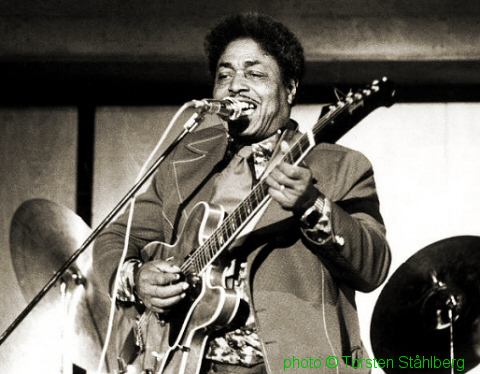
Johnny Shines

Johnny Shines (April 26, 1915 – April 20, 1992) was an American blues singer and guitarist. According to the music journalist Tony Russell, "Shines was that rare being, a blues artist who overcame age and rustiness to make music that stood up beside the work of his youth. When Shines came back to the blues in 1965 he was 50, yet his voice had the leonine power of a dozen years before, when he made records his reputation was based on".He was born John Ned Shines in Frayser, Tennessee. He spent most of his childhood in Memphis, Tennessee playing slide guitar at an early age in local “jukes” and for tips on the streets. He was "inspired by the likes of Charley Patton, Blind Lemon Jefferson, Lonnie Johnson, and the young Howlin' Wolf", but he was taught to play the guitar by his mother.Shines moved to Hughes, Arkansas in 1932 and worked on farms for three years putting his musical career on hold. It was this chance meeting with Robert Johnson, his greatest influence, that gave him the inspiration to return to music. In 1935, Shines began traveling with Johnson, touring the south and heading as far north as Ontario where they appeared on a local radio program. The two went their separate ways in 1937, one year before Johnson's death.Shines played throughout the southern United States until 1941 when he settled in Chicago. There Shines found work in the construction industry but continued to play in local bars.

He made his first recording in 1946 for Columbia Records, but the takes were never released.He recorded for Chess in 1950, and was once again denied release. He kept playing with local blues musicians in the Chicago area for several more years. In 1952, Shines recorded what is considered his best work for the J.O.B. Records label. The recordings were a commercial failure and Shines, frustrated with the music industry, sold his equipment and returned to construction.
In 1966, Vanguard Records found Shines taking photographs in a Chicago blues club and had him record tracks for the third installment of Chicago/The Blues/Today! The album has since then become a blues classic and it brought Shines into the mainstream music scene.In the late 1960s and 1970s, Shines toured with Robert Johnson's stepson, Robert Lockwood, Jr. as the last remaining original delta blues musicians. In 1980, Shines' music was brought to a standstill when he suffered a stroke. He would later appear, and play, in the 1991 documentary The Search for Robert Johnson and manage to release one last album, Back To The Country, which won a W.C. Handy Award. It featured playing from Snooky Prior and Johnny Nicholas.
In the mid 1980s Shines was "adopted" by a group of Tuascaloosa blues lovers. The core of this group was Debbie Bond and her Kokomo Blues Band. The group kept Shines socially active, taking him to gigs by local and national Blues musicians, and Debbie kept him supplied with vitamins and minerals to reduce the affects of the stroke and drinking relapses. Shines had very little income and lived in a simple cinderblock apartment in a rough section of Tuscaloosa. In 1985, Tuascaloosa's National Public Radio station produced a show honoring Shine's birthday. The Mayor of Tuscaloosa proclaimed Johnny Shines Day and presented him a Key to the City. During this perios, Shines was also cared for by his girlfriend, Miss Candy.

In 1989 Shines came to California to play a month long tour hitting universities (UC Santa Cruz) and clubs, ranging as far north as San Francisco's "Slims", where he played an acoustic set with David Schnittman backing him on guitar plus a mandolin player. For the rest of his shows Johnny used a local Santa Cruz CA blues band named "Blue Magic". The band leader was the late Gary Martin (guitar/vocals) David Schnittman (Bass) and Scott Cooper (drums). Johnny had suffered a stroke a few years earlier but his voice retained its legendary power. However he could no longer "fret" his guitar with his left hand and played only "slide" guitar; both on his acoustic and electric guitars. Johnny and the Blue Magic ranged as far south as the Belly Up club in San Diego and the "Palomino Club in Los Angeles. At these two southern California dates Johnny shared the stage with Clarence "Gatemouth" Brown. Shines died on 20 April 1992, in Tuscaloosa, Alabama. He was inducted into the Blues Hall of Fame later the same year.

Wednesday, July 13, 2011

J. W. Warren

J.W. Warren was born in 1921 in Enterprise, AL. In a family of eleven children, he was the only one to take up music, starting at the age of fifteen or sixteen. He entered the military as a young adult and served for 14 years. After serving in the military, he started farming and begain to play barbeques at house parties in southeast Alabama.
"I came up the hard way. I never had a break whatsoever. In other words, I never had a break in my life. I was born in the wrong part of the world and then again I didn't go any place else. My daddy gave me a good raising and I know how to treat people, how to be respectful to folks. I like that. But I had too much trouble in my life. I didn't do anything with the talent I had because I didn't have much education. When you got a back break like I had you doubt yourself, you know it's rough man!"
In his young days he dated Big Mamma Thornton when they were scuffling around together in Alabama juke joints. When Tim Duffy met him he told him that he had given up his music. Duffy convinced him to record and was amazed by his original story songs and his guitar style in which he employed his old jack-knife for a slide. J.W. Warren died of a heart attack at his home in Ariton, AL, on the afternoon of August 5, 2003. Posthumously recorded by Fat possum Records "Life Ain't Worth Living"

Friday, July 1, 2011

Garfield Akers

Garfield Akers (b. 1901 or 1902, Brights or Bates, Mississippi, d. between 1953 and 1959, probably in Memphis, Tennessee) was a blues singer and guitarist. He sometimes performed under the pseudonym "Garfield Partee."The throbbing guitar sound of Garfield Akers was a primary influence on subsequent generations of Mississippi bluesmen, with the likes of John Lee Hooker and Robert Wilkins citing him as an influence!
Born around 1902 in Bates, Mississippi, Akers remains a shadowy figure; after honing his skills at local dances and house parties, he relocated to the Hernando area, where he worked by day as a sharecropper. After moving on to Memphis, in 1929 he made his first Vocalion label recordings at the Peabody, accompanied by guitarist Joe Callicott; between this first date and a 1930 session for Brunswick, four Akers performances still exist - his two-part signature "Cottonfield Blues," "Jumpin' and Shoutin' Blues," and "Dough Roller Blues," one of the first variations on Hambone Willie Newbern's seminal "Roll and Tumble."
His most well-known song is his debut, the Cottonfield Blues, which Don Kent praised with the words "only a handful of guitar duets in all blues match the incredible drive, intricate rhythms and ferocious intensity" and called Akers "one of the greatest vocalists in blues history". Michael Gray appreciated it as "the birth of rock ’n’ roll … from 1929!"
Akers' extant recordings consist of four sides, which are nonetheless historically significant. His most well-known song was his debut, "Cottonfield Blues", a duet with friend and longtime collaborator Joe Callicott on second guitar, based on a song performed by Texas Bluesman Henry Thomas a few years prior.
Akers lived in Hernando, Mississippi most of his life, working as a sharecropper and performing during off-hours at local house parties and dances. He toured with Frank Stokes on the Doc Watts Medicine Show. Akers was reportedly active on the south Memphis circuit throughout the 1930s. Akers and Callicott played together for more than twenty years, parting in the mid-1940's. Akers briefly resurfaced in the early 1950s, shortly before his death at a historically undetermined date. No photographs of Akers are known to exist.Nothing is known about Akers after the pair split as a performing duo although it is believed that he died around the end of the 1950's or the beginning of the 1960's, possibly in Memphis.


Monday, June 13, 2011

Kenny Brown

Kenny Brown is a blues slide guitarist from Nesbit, Mississippi.Born in Selma, Alabama, in 1953, his family moved to Nesbit, Mississippi, when he was less than a year old. Kenny developed an interest in playing guitar at the age of ten and began teaching himself the basics. Two years later, the bluesman Joe Callicott moved in next door, and Kenny’s fate was sealed. This unlikely pair would spend hours together, whether in the morning before Kenny had to be at school or in the evening as soon as Kenny came home.
On some nights, Kenny would hear the music coming from Othar Turner's place down the way. Growing up in this part of Mississippi, Kenny was surrounded by musicians: Junior Kimbrough, Fred McDowell, and R. L. Burnside. Their influence wasn’t wasted on this young white boy, and Kenny made sure to prove himself to them all.
Kenny became skilled in the North Mississippi Hill Country blues style popularized by his mentor R. L. Burnside,he began his career by apprenticing with Mississippi Joe Callicott, Johnny Woods, and Mississippi Fred McDowell.He has also cited Muddy Waters,Jessie Mae Hemphill,Junior Kimbrough,Johnny Winter,and Johnny Shines as influences.In 1971 Brown began performing with R. L. Burnside.By the age of eighteen he was playing with Burnside’s band; over the next thirty or so years together, they would tour all over the world. Burnside often referred to Kenny as his “adopted son”and affectionately called him "white boy on guitar" and "my white son." Both Brown and Burnside have noted the singularity of Brown's being a white musician playing in the previously predominantly African American genre of North Mississippi Hill Country blues.Brown's guitar work was featured in the 2006 film Black Snake Moan, where he provided backing for star Samuel L. Jackson's vocals. He can also be seen in the film's climax as a guitarist in a blues band, playing alongside Burnside's grandson Cedric.
He has also performed with rock bands Widespread Panic and the Jon Spencer Blues Explosion. He has recorded one album for the Fat Possum Records label (Stingray), and his most recent double-album "Can't Stay Long" was released in June 2011 on Devil Down Records .


Wednesday, June 1, 2011

Rev Utah Smith The Two Wings Preacher

Rev. Utah Smith (1906 - 1965) first was a "traveling evangelist" out of the Churches Of God In Christ before he settled in New Orleans. There he founded the Two Wings Temple and the song "Two Wings" became his "theme song". Smith oftentimes used two wings while singing this song. Even before he came to New Orleans he played an electric guitar. He toured the South and was famous for this particular song. Smith recorded "Two Wings" first in 1944, but the 1953 recording is the more famous one. Sister Rosetta Tharpe stated Smith being one of the great "old" guitar players in gospel music. Smith's "Two Wings" might be a good example of simple southern community singing.Almost nothing else has been known about the life of sanctified electric guitar preacher Elder Utah Smith .“I vividly remember the first time I heard Reverend Utah Smith in 1965 on a 78 rpm record on the Two Wing Temple label. God, what a sound! Screaming vocals by Rev. Smith, heated responses by a chorus of young women, and manic, distorted electric guitar with the volume knob turned all the way up. Since that time I have longed to know more about this mysterious evangelist and pioneer of the electric guitar but have learned very little.It turns out that Smith was a major player in the growth of America's largest predominantly black Pentecostal denomination.”
– Dr. David Evans, The University of Memphis