Sunday, December 1, 2013

Washington Phillips


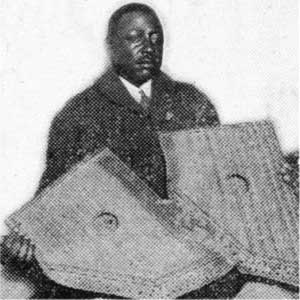
Washington Phillips (January 11, 1880 – September 20, 1954) was a Texan gospel singer and musician.The mystery begins the first time you hear the flowing gospel of Washington Phillips, whose entire recorded output consists of 18 songs recorded from 1927- 1929. His sweetly-sung Christian blues, bathed in a celestial haze of notes from an instrument that sounds like a child's music box, stand out amongst the work of guitar evangelists and street corner Scripture-ites of the era. Phillips' sacred porch songs provide evidence of a higher power, for how could man alone create music for the angels? After his five sessions in a Dallas studio, where he'd been summoned by Columbia Records field recorder Frank Walker, Phillips faded back into obscurity. Ry Cooder led a slight revival in 1971, when he covered Phillips' "Denomination Blues," and newer bands, such as Austin's Knife In the Water, have interpreted his moralistic lullabies for the art rock crowd. For the most part, however, Phillips is virtually unknown except to a cult of rabid musicologists, who revel in the mystique of the man who emerged out of nowhere as a fully-formed artist and just as quickly disappeared.Phillips had some success with his first '78, "Take Your Burden To the Lord" b/w "Lift Him Up That's All," which sold just over 8,000 copies in 1928. (An average Bessie Smith record at the time would sell about 10,000.) Then came the stock market crash of 1929 and the Great Depression. The scouts and field recorders stopped coming from New York in search of raw talent and the labels instead focused on making more refined records which would comply with the escapism sought by a dire populace. In the 1920's, Texans such as blind Pentecostal pianist Arizona Juanita Dranes of Dallas and Marlin's Blind Willie Johnson, whose classic compositions have been covered by Led Zeppelin ("Nobody's Fault But Mine") and Eric Clapton ("Motherless Children") were spicing "Negro spirituals" and songs of praise with barrelhouse piano and slide guitar before anyone else. But the innovative recordings from Texas suddenly stopped. Like Phillips, Dranes made her last recordings in 1929 and Johnson never stepped inside a studio again after April 1930. The "real" Washington Phillips returned to the farming life in the black settlement of Simsboro, content to play for neighbors and churchgoers until 1954, when, at age 74, he died of head injuries suffered from a fall down the stairs at the welfare office in nearby Teague. It turned out that the body had been exhumed the day after it was buried and taken back to Teague, about sixty miles east of Waco, by brother Sim Phillips. Phillips died in 1954 in Teague, Texas.Phillips recorded eighteen songs, all between 1927 and 1929, though only sixteen survive. Some of his songs amount to highly specific and detailed gospel sermons, featuring Phillips' voice self-accompanied by an instrument that sounds like a fretless zither. This instrument, which has been variously identified as a Dolceola, a Celestaphone, two Celestaphones tuned in octaves attached side-by-side, or a Phonoharp (and also is considered by some to be an instrument entirely home-made by Phillips) creates a unique sound on these recordings that makes them immediately recognizable.

Wednesday, November 13, 2013

The Black Ace


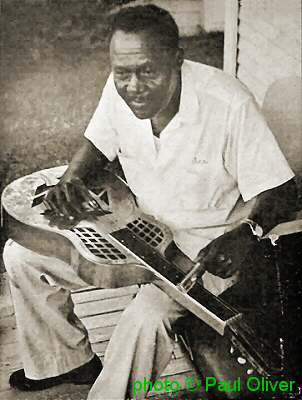
Black Ace was the most frequently used stage name of the American Texas blues musician, Babe Kyro Lemon Turner (December 21, 1905 – November 7, 1972),who was also known as B.K. Turner, Black Ace Turner or Babe Turner. Born in Hughes Springs, Texas, United States,he was raised on the family farm, and taught himself to play guitar, performing in east Texas from the late 1920s on. During the early 1930s he began playing with Smokey Hogg and Oscar "Buddy" Woods, a Hawaiian-style guitarist who played with the instrument flat on his lap.Turner then bought a National steel guitar, and began playing what one later critic called "Hawaii meets the Delta," smooth and simple blues. In 1937, Turner recorded six songs (possibly with Hogg as second guitarist) for Chicago's Decca Records in Dallas, including the blues song "Black Ace".In the same year, he started a radio show on KFJZ in Fort Worth, using the cut as a theme song, and soon assumed the name.In 1941 he appeared in The Blood of Jesus, an African-American movie produced by Spencer Williams Jr. In 1943 he was drafted into the United States Army, and gave up playing music for some years.[4] However, in 1960, Arhoolie Records owner Chris Strachwitz persuaded him to record an album for his record label. His last public performance was in the a 1962 film documentary, The Blues, and he died of cancer in Fort Worth, Texas, in 1972.

Wednesday, October 2, 2013

George "Little Hat" Jones


JONES, GEORGE [LITTLE HAT] (1899–1981). Blues musician George "Little Hat" Jones was born on a farm near the Sulphur River in Bowie County, Texas, on October 5, 1899, the only child of Felix Jones and his wife. The family farm was purchased by Jones's grandfather, a former slave. Jones was a talented, though little-known, blues musician. He quit school at the age of thirteen, after his father became ill and several crops were destroyed, in order to help out on the farm. During this period his mother bought him his first guitar. Between 1916 and 1929 he probably worked as a menial laborer. He acquired his nickname at a construction job in Garland. Because Jones came to work with a hat from which half the brim had been cut off, his boss called him "Little Hat" Jones and even made out his paychecks this way.In 1929 Jones was in San Antonio. He first recorded, for OKeh Records, on June 15 of that year, when he cut two records of his own, "New Two Sixteen Blues" and "Two String Blues," and played backup for Texas Alexander. Jones then made a contract with OKeh for three years and recorded "Rolled from Side to Side Blues," "Hurry Blues," "Little Hat Blues," "Corpus Blues," "Kentucky Blues," "Bye Bye Baby Blues," "Cross the Water Blues," and "Cherry Street Blues." He also played in such cities as New Orleans, Galveston, and Austin, and occasionally ventured into Mexico. He was influenced in his guitar playing by Blind Lemon Jefferson and played with T. Texas Tyler and Jimmie Rodgers.In 1937 Jones settled in Naples, Texas, with his second wife, Janie Traylor, and worked at odd jobs. In the years before his death he was employed at the Red River Army Depot. He died on March 7, 1981, and is buried in the Morning Star cemetery in Naples.