Wednesday, January 1, 2014

Terry "Harmonica" Bean


Terry “Harmonica” Bean is still relatively young, but has decades of experience with the blues. A lifelong resident of Pontotoc, Bean first heard downhome blues at home. His father Eddie Bean, a native of Bruce, sang and played blues guitar and prior to Terry’s birth traveled with an electric blues band. For many years Eddie Bean, who died in 1985, hosted informal music and gambling gatherings at the family’s house on “Bean Hill” in west Pontotoc. He also worked as a sharecropper, enlisting Terry and other of his fourteen children to pick cotton in the surrounding fields. Terry began playing guitar and harmonica as a child, and eventually his father began featuring him at the home gatherings and taking him along to other house parties. Although Terry was a “natural,” he stopped playing around the time he was twelve because several of his brothers were jealous of the attention he received. Today his brother Jimmy plays bass in church and occasionally in Terry’s blues band, while brother Jerry Lee sings gospel as well as lead vocals in the Pontotoc-based Legends of the Blues. Terry turned his attention instead to baseball, and was a star pitcher on American Legion league teams and his high school team, which he led to the state championship in 1980. Equally adept with both hands, Terry pitched five no-hitters and attracted scouts from several professional teams. A professional career in baseball was curtailed, however, when Terry was injured in a motorcycle accident and he lost his competitive edge. Nevertheless, he continued to play semi-pro ball in his ‘20s until he was involved in another automotive accident. Terry decided to “get serious” about the blues in 1988 after visiting the Delta Blues Festival in Greenville. He went there to see Robert Junior Lockwood, who played with Terry’s idol, harmonica legend Little Walter, but inadvertently fell in with the Greenville blues scene. Every weekend for three years Terry traveled to Greenville and its environs to play harmonica with James "T-Model" Ford as well as Asie Payton at various juke joints. He also played across the Delta with artists including Lonnie Pitchford. Back home he formed a band, and began playing guitar himself after becoming frustrated with teaching others his ideal sound. Following the lead of Arkansas bluesman John Weston, he started using a harmonica rack and performing as a one-man band, stomping his feet for percussion. Since the mid-‘80s Terry has worked full-time at a furniture factory in Pontotoc, but he has maintained a busy performance schedule as both a solo artist and with the Terry Harmonica Bean Blues Band. He has performed at festivals across Mississippi as well as in Alabama, Arkansas, Missouri, and Tennessee, and regularly works at clubs across the region. Since 2002 he has released six self-produced CDs that document both his band and solo performances. Terry is consciously dedicated to “keeping alive” older styles of blues. “What’s stimulating to me,” he says, “is people hearing the blues played like they used to hear it.” -Scott Barretta

Sunday, December 22, 2013

Rev KM Williams in Israeli News network


January 13, 2013 - Blues instance, Pastor KM Williams, heating - Danny Dorchin and Noam Dayan. Saturday 01/12/2013. Attended, photographed and touched Blues reports - Yuval Erel. The article was also published in " megaphone "independent newspaper network. Pastor Kay. Um. Williams Israel. Photo: Yuval Erel Pastor Kay. Um. Williams Israel. Photo: Yuval Erel African American pastor sermon on Saturday night, sounds reasonable, but this time we are dealing sermon blues with lots of love to Israel IsraelA lot of love of Israel back, so you can summarize what happened in the show summarizing the visit to Israel by Pastor Ki. um Williams of Houston, Texas, a kind of messenger blues. Blues is a musical style and vocal and instrumental based on the pentatonic scale and typically the characteristics of harmonic progression of 12 boxes. Blues has many incarnations in the folk style in the cotton fields of the Mississippi Delta to Rock - Blues of the late sixties style. However, the Blues felt in all styles of popular music. The origin of the blues is in the United States, the singing of African slaves. This included singing work songs, religious songs and characteristics of African-rooted music. This style is considered to be poetical, melodic, harmonic and has its own special rhythm, which distinguishes it from any other musical style. When they entered the electrical instruments massive use of music in the fifties, the blues was the basis for the birth of rock and roll, which marked a new era in music history. Blues greatly influenced popular music and led to the myriad styles representing the weight of modern Western music: jazz, rhythm and blues, rock, metal, country and even some influences on modern classical music. l After the show - North Mississippi AllStars, after the visit of Robert Balfour, a young man of 71 north Mississippi community Hblozistim gave Israel a valuable lesson how to play the "blue sadness that" it's the next step - Pastor Kay. Um Williams , say that he is " stiff as dry skin of a snake in the deserts of the south, as beautiful as the sunrise over the Gulf of Mexico west and slashing as the Red River north of the country, next to him was born 56 years ago . " Rumor just like in fairy tales, Williams learned to play more as a child playing blues drifter who moved to the city ...
Williams, had a very brief visit here to appear before hundreds of addicts genre temple local rock Barbie participate artist's workshop in the creator, to appear before the crowd in Jerusalem on a Friday night cold and snowy and summarize his visit to Israel concert blues, right, in the basement (Lbontinsba) dank and dark intimate but packed to capacity with a young audience in spirit but his silver hair. The show started a local heating of Noam Dayan and Danny Dorchin gave much respect to the genre, and the time has come for this. Then came the priest, a black suit, shirt unbuttoned, tie fifty shades of gray, leather shoes and a hat Borsalino Black decorated, ready to demand that the Sermon on Sunday at church, but this time it was the church of a different kind, the Church of the Blues, a show of nearly two hours without a break, Booty types of guitars, accompanied by drummer Yonatan Bar Rashi and some songs even Danny Dorchin joined with Wonder harmonica ...
Pastor periodically bestows love on the audience, wisdom and true wisdom, handed my ears crowd the real roots of the blues, rough, dirty, popular, direct, without flattering and impartially. The essence of the experience occurred the evening could keep using photos and some video clips, those who felt listening, understand ... Video

Sunday, December 1, 2013

Washington Phillips


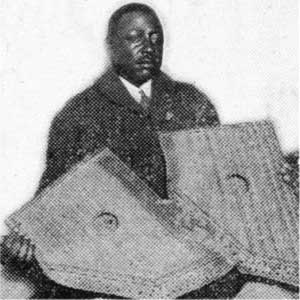
Washington Phillips (January 11, 1880 – September 20, 1954) was a Texan gospel singer and musician.The mystery begins the first time you hear the flowing gospel of Washington Phillips, whose entire recorded output consists of 18 songs recorded from 1927- 1929. His sweetly-sung Christian blues, bathed in a celestial haze of notes from an instrument that sounds like a child's music box, stand out amongst the work of guitar evangelists and street corner Scripture-ites of the era. Phillips' sacred porch songs provide evidence of a higher power, for how could man alone create music for the angels? After his five sessions in a Dallas studio, where he'd been summoned by Columbia Records field recorder Frank Walker, Phillips faded back into obscurity. Ry Cooder led a slight revival in 1971, when he covered Phillips' "Denomination Blues," and newer bands, such as Austin's Knife In the Water, have interpreted his moralistic lullabies for the art rock crowd. For the most part, however, Phillips is virtually unknown except to a cult of rabid musicologists, who revel in the mystique of the man who emerged out of nowhere as a fully-formed artist and just as quickly disappeared.Phillips had some success with his first '78, "Take Your Burden To the Lord" b/w "Lift Him Up That's All," which sold just over 8,000 copies in 1928. (An average Bessie Smith record at the time would sell about 10,000.) Then came the stock market crash of 1929 and the Great Depression. The scouts and field recorders stopped coming from New York in search of raw talent and the labels instead focused on making more refined records which would comply with the escapism sought by a dire populace. In the 1920's, Texans such as blind Pentecostal pianist Arizona Juanita Dranes of Dallas and Marlin's Blind Willie Johnson, whose classic compositions have been covered by Led Zeppelin ("Nobody's Fault But Mine") and Eric Clapton ("Motherless Children") were spicing "Negro spirituals" and songs of praise with barrelhouse piano and slide guitar before anyone else. But the innovative recordings from Texas suddenly stopped. Like Phillips, Dranes made her last recordings in 1929 and Johnson never stepped inside a studio again after April 1930. The "real" Washington Phillips returned to the farming life in the black settlement of Simsboro, content to play for neighbors and churchgoers until 1954, when, at age 74, he died of head injuries suffered from a fall down the stairs at the welfare office in nearby Teague. It turned out that the body had been exhumed the day after it was buried and taken back to Teague, about sixty miles east of Waco, by brother Sim Phillips. Phillips died in 1954 in Teague, Texas.Phillips recorded eighteen songs, all between 1927 and 1929, though only sixteen survive. Some of his songs amount to highly specific and detailed gospel sermons, featuring Phillips' voice self-accompanied by an instrument that sounds like a fretless zither. This instrument, which has been variously identified as a Dolceola, a Celestaphone, two Celestaphones tuned in octaves attached side-by-side, or a Phonoharp (and also is considered by some to be an instrument entirely home-made by Phillips) creates a unique sound on these recordings that makes them immediately recognizable.

Wednesday, November 13, 2013

The Black Ace


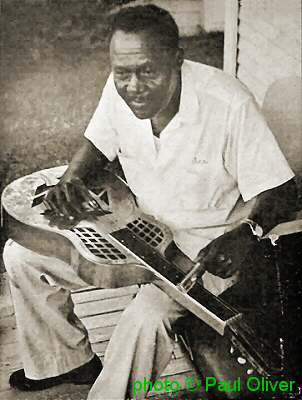
Black Ace was the most frequently used stage name of the American Texas blues musician, Babe Kyro Lemon Turner (December 21, 1905 – November 7, 1972),who was also known as B.K. Turner, Black Ace Turner or Babe Turner. Born in Hughes Springs, Texas, United States,he was raised on the family farm, and taught himself to play guitar, performing in east Texas from the late 1920s on. During the early 1930s he began playing with Smokey Hogg and Oscar "Buddy" Woods, a Hawaiian-style guitarist who played with the instrument flat on his lap.Turner then bought a National steel guitar, and began playing what one later critic called "Hawaii meets the Delta," smooth and simple blues. In 1937, Turner recorded six songs (possibly with Hogg as second guitarist) for Chicago's Decca Records in Dallas, including the blues song "Black Ace".In the same year, he started a radio show on KFJZ in Fort Worth, using the cut as a theme song, and soon assumed the name.In 1941 he appeared in The Blood of Jesus, an African-American movie produced by Spencer Williams Jr. In 1943 he was drafted into the United States Army, and gave up playing music for some years.[4] However, in 1960, Arhoolie Records owner Chris Strachwitz persuaded him to record an album for his record label. His last public performance was in the a 1962 film documentary, The Blues, and he died of cancer in Fort Worth, Texas, in 1972.