Discover who's Playing on the Backporch at Rev. KM Williams' CountryBluesTown!
Monday, March 23, 2009
Sunday, March 15, 2009
LIL Son Jackson - East Texas Country Bluesman

* Born: August 16, 1915, Tyler, TX
* Died: May 30, 1976, Dallas, TX
* Active: '40s, '50s, '60s
* Genres: Blues
* Instrument: Vocals, Guitar
* Representative Albums: "Lil' Son Jackson," "Blues Come to Texas," "Rockin' and Rollin', Vol. 1: 1948-1950"
Biography
Lil' Son Jackson was a stylistic throwback from the moment he first turned up during the immediate postwar era. Born Melvin Jackson, he was a Texas country bluesman of the highest order whose rustic approach appealed wholeheartedly to the early-'50s blues marketplace. His dad loved blues, while his mother played gospel guitar. Their son's initial experience came with a spiritual aggregation called the Blue Eagle Four. A mechanic by trade, he served in the Army during World War II before giving the idea of being a professional blues musician a shot. In 1946, he shipped off a demo to Bill Quinn, who owned a Houston diskery called Gold Star Records. Quinn was suitably impressed, inking Jackson and enjoying a national R&B hit, "Freedom Train Blues," in 1948 for his modest investment. It would prove Jackson's only national hit, although his 1950-1954 output for Imperial Records must have sold consistently, judging from how many sides the L.A. firm issued by the Texas guitarist. Jackson's best Imperial work was recorded solo. Later attempts to squeeze his style into a small band format (his idea, apparently) tended to emphasize his timing eccentricities. His "Rockin' and Rollin'," cut in December of 1950, became better known through a raft of subsequent covers as "Rock Me Baby." He gave up the blues during the mid-'50s after an auto wreck, resuming work as a mechanic. Arhoolie Records boss Chris Strachwitz convinced Jackson to cut an album in 1960.Jackson had something of a second career when Chris Strachwitz of Arhoolie located him during the summer of 1960 in Dallas and convinced Jackson to try recording once again. From these sessions came nearly two dozen songs in the traditional Texas blues style that seems to be an offshoot from the music of the Mississippi delta region. Among the tracks included in this reissue are 'Blues Come to Texas,' 'West Dallas Blues,' 'I Walked from Dallas,' and, in something of a stretch, 'Cairo Blues,' a particularly fine performance. This is a fine collection.” Jackson died May 30, 1976, in Dallas, TX, from cancer. ~ Bill Dahl, All Music Guide
Answers.com
Tuesday, February 24, 2009
Frankie Lee Sims - Texas Country Bluesman
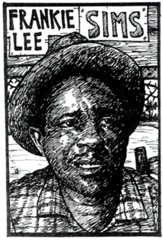
A traditionalist who was a staunch member of the Texas country blues movement of the late '40s and early '50s (along with the likes of his cousin Lightnin' Hopkins, Lil' Son Jackson, and Smokey Hogg), guitarist Frankie Lee Sims developed a twangy, ringing electric guitar style that was irresistible on fast numbers and stung hard on the downbeat stuff.
Sims picked up a guitar when he was 12 years old. By then, he had left his native New Orleans for Marshall, TX. After World War II ended, he played local dances and clubs around Dallas and crossed paths with T-Bone Walker. Sims cut his first 78s for Herb Rippa's Blue Bonnet Records in 1948 in Dallas, but didn't taste anything resembling regional success until 1953, when his bouncy "Lucy Mae Blues" did well down south.
The guitarist recorded fairly prolifically for Los Angeles-based Specialty into 1954, then switched to Johnny Vincent's Ace label (and its Vin subsidiary) in 1957 to cut the mighty rockers "Walking with Frankie" and "She Likes to Boogie Real Low," both of which pounded harder than a ballpeen hammer.
Sims claimed to play guitar on King Curtis's 1962 instrumental hit "Soul Twist" for Bobby Robinson's Enjoy label, but that seems unlikely. It is assumed that he recorded for Robinson in late 1960 (the battered contents of three long-lost acetates emerged in 1985 on the British Krazy Kat label).
Sims mostly missed out on the folk-blues revival of the early '60s that his cousin Lightnin' Hopkins cashed in on handily. When he died at age 53 in Dallas of pneumonia, Sims was reportedly in trouble with the law due to a shooting incident and had been dogged by drinking problems. ~ Bill Dahl, All Music Guide. Similar Artists:
Andrew "Smokey" Hogg, Melvin "Lil' Son" Jackson, Forest City Joe Influenced By:
Lightnin' Hopkins, T-Bone Walker, Blind Lemon Jefferson, John Lee Hooker
* Born: April 30, 1917, New Orleans, LA
* Died: May 10, 1970, Dallas, TX
* Active: '40s, '50s, '60s
* Genres: Blues
* Instrument: Vocals, Guitar
* Representative Albums: "Lucy Mae Blues," "Walking with Frankie"
* Representative Songs: "Lucy Mae Blues," "She Likes to Boogie Real Low," "Walkin' With Frankie"
Sims picked up a guitar when he was 12 years old. By then, he had left his native New Orleans for Marshall, TX. After World War II ended, he played local dances and clubs around Dallas and crossed paths with T-Bone Walker. Sims cut his first 78s for Herb Rippa's Blue Bonnet Records in 1948 in Dallas, but didn't taste anything resembling regional success until 1953, when his bouncy "Lucy Mae Blues" did well down south.
The guitarist recorded fairly prolifically for Los Angeles-based Specialty into 1954, then switched to Johnny Vincent's Ace label (and its Vin subsidiary) in 1957 to cut the mighty rockers "Walking with Frankie" and "She Likes to Boogie Real Low," both of which pounded harder than a ballpeen hammer.
Sims claimed to play guitar on King Curtis's 1962 instrumental hit "Soul Twist" for Bobby Robinson's Enjoy label, but that seems unlikely. It is assumed that he recorded for Robinson in late 1960 (the battered contents of three long-lost acetates emerged in 1985 on the British Krazy Kat label).
Sims mostly missed out on the folk-blues revival of the early '60s that his cousin Lightnin' Hopkins cashed in on handily. When he died at age 53 in Dallas of pneumonia, Sims was reportedly in trouble with the law due to a shooting incident and had been dogged by drinking problems. ~ Bill Dahl, All Music Guide. Similar Artists:
Andrew "Smokey" Hogg, Melvin "Lil' Son" Jackson, Forest City Joe Influenced By:
Lightnin' Hopkins, T-Bone Walker, Blind Lemon Jefferson, John Lee Hooker
* Born: April 30, 1917, New Orleans, LA
* Died: May 10, 1970, Dallas, TX
* Active: '40s, '50s, '60s
* Genres: Blues
* Instrument: Vocals, Guitar
* Representative Albums: "Lucy Mae Blues," "Walking with Frankie"
* Representative Songs: "Lucy Mae Blues," "She Likes to Boogie Real Low," "Walkin' With Frankie"
Tuesday, February 10, 2009
Blind Lemon Jefferson - Father of Texas Blues
Blind" Lemon Jefferson (September 24, 1893 – December 1929) was an influential blues singer and guitarist from Texas. He was one of the most popular blues singers of the 1920s, and has been titled "Father of the Texas Blues."His musical style was individualistic, and Jefferson's singing and self-accompaniment were distinctive as a result of his high-pitched voice and originality on the guitar.[6] He was not influential on some younger blues singers of his generation, as they did not seek to imitate him as they did other commercially successful artists.[7] However, later blues and rock and roll musicians attempted to imitate both his songs and his musical style.Jefferson was born blind near Coutchman, Texas in Freestone County, near present-day Wortham, Texas.[3] Jefferson was one of eight children born to sharecroppers Alex and Clarissa Jefferson.[3] Disputes regarding his exact birth date derive from contradictory census records and draft registration records. By 1900, the family was farming southeast of Streetman, Texas, and Lemon Jefferson's birth date is indicated as September 1893 in the 1900 census.Jefferson began playing the guitar in his early teens, and soon after he began performing at picnics and parties.[3] He also became a street musician, playing in East Texas towns in front of barbershops and on corners.By the early 1910s, Jefferson began traveling frequently to Dallas, where he met and played with fellow blues musician Leadbelly.[13] In Dallas, Jefferson was one of the earliest and most prominent figures in the blues movement developing in Dallas' Deep Ellum area. Jefferson likely moved to Deep Ellum in a more permanent fashion by 1917, where he met Aaron Thibeaux Walker, also known as T-Bone Walker.[13] Jefferson taught Walker the basics of blues guitar, in exchange for Walker's occasional services as a guide.in December 1925 or January 1926, he was taken to Chicago, Illinois, to record his first tracks. Uncharacteristically, Jefferson's first two recordings from this session were gospel songs ("I Want to be like Jesus in my Heart" and "All I Want is that Pure Religion"), released under the name Deacon L. J. Bates. This led to a second recording session in March 1926. His first releases under his own name, "Booster Blues" and "Dry Southern Blues," were hits; this led to the release of the other two songs from that session, "Got the Blues" and "Long Lonesome Blues," which became a runaway success, with sales in six figures. He recorded about 100 tracks between 1926 and 1929; 43 records were issued.Jefferson is known to have done an unusual amount of traveling for the time in the American South, which is reflected in the difficulty of pigeonholing his music into one regional category.Jefferson had an intricate and fast style of guitar playing and a particularly high-pitched voice. He was a founder of the Texas blues sound and an important influence on other blues singers and guitarists, including Lead Belly and Lightnin' Hopkins.
He sticks to no musical conventions, varying his riffs and rhythm and singing complex and expressive lyrics in a manner exceptional at the time for a "simple country blues singer."Jefferson was reputedly unhappy with his royalties (although Williams said that Jefferson had a bank account containing as much as $1500). In 1927, when Williams moved to OKeh Records, he took Jefferson with him, and OKeh quickly recorded and released Jefferson's "Matchbox Blues" backed with "Black Snake Moan," which was to be his only OKeh recording, probably because of contractual obligations with Paramount. Jefferson's two songs released on Okeh have considerably better sound quality than on his Paramount records at the time. When he had returned to Paramount a few months later, "Matchbox Blues" had already become such a hit that Paramount re-recorded and released two new versions, under producer Arthur Laibly.In 1927, Jefferson recorded another of his now classic songs, the haunting "See That My Grave Is Kept Clean" (once again using the pseudonym Deacon L. J. Bates) along with two other uncharacteristically spiritual songs, "He Arose from the Dead" and "Where Shall I Be." Of the three, "See That My Grave Is Kept Clean" became such a big hit that it was re-recorded and re-released in 1928. Jefferson died in Chicago in December 1929. The cause of death is unknown, and though rumors swirled that a jealous lover poisoned his coffee, a more likely scenario is that he died due to a heart attack after being disoriented during a snowstorm (another scenario is that he froze to death). The book "Tolbert's Texas" claims that he was killed while being robbed of a large royalty cash payment by a guide taking him to Union Station to catch a train home to Texas. Paramount Records paid for the return of his body to Texas by train, accompanied by pianist Will Ezell. Jefferson was buried at Wortham Negro Cemetery (now Wortham Black Cemetery). Far from his grave being kept clean, it was unmarked until 1967, when a Texas Historical Marker was erected in the general area of his plot, the precise location being unknown. By 1996, the cemetery and marker were in poor condition, but a new granite headstone was erected in 1997. In 2007 the cemetery's name was changed to Blind Lemon Memorial Cemetery . Blind Lemon Jefferson is the featured musician on a State of Texas license plate. B. B. King has always maintained that Jefferson was a huge influence on his singing and guitar playing. The Rock and Roll Hall of Fame listed one song by Blind Lemon Jefferson of the 500 songs that shaped rock and roll.
Monday, January 26, 2009
Rev. Pearly Brown Piedmont Guitar Evangelist
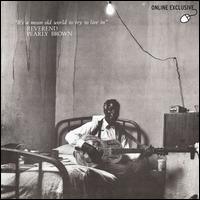
Quite possible the last of the great blues street singers, Rev. Pearly Brown was born August 18, 1915, in Abbeville, GA. Blind from birth, he grew up in Americus, GA, where he reportedly learned to play guitar at the age of seven. As a young man he began to busk on the streets in Americus, eventually moving on to Macon, where he was a fixture on the streets for several decades. His repertoire drew heavily on Blind Willie Johnson, whose slide style he made his own. Like Johnson, he played a kind of blues gospel, singing spirituals and what Brown called "slave songs," along with country songs like "Great Speckled Bird" that had a strong spiritual content. He tasted a good deal of success in the 1960s, frequently playing large jazz and blues festivals, even opening for touring rock bands, and he was the first black performer to play on The Grand Old Opry. Rumor has it that he mentored both Duane Allman and Dickey Betts on the slide guitar. A solid singer and an often brilliant guitar player, Brown's discography is small but of high quality. Henry Oster recorded him in Macon in 1961 for the album Georgia Street Singer, which was released on Oster's Folk-Lyric label. In 1973 Bill Nowlin recorded It's a Mean Old World to Try to Live In for Rounder Records. A documentary on Brown called Mean Old World was filmed by John English in 1975, and eventually was combined with a film about bluesman Arthur "Big Boy" Crudup entitled Born in the Blues and released on video in 1997. Rev. Brown continued to sing on the streets of Macon until 1979, when poor health forced him to retire. He died in 1986. ~ Steve Leggett, All Music Guide
Representative Albums:
Georgia Street Singer, You're Gonna Need That Pure Religion, It's a Mean Old World to Try To Live in
Representative Albums:
Georgia Street Singer, You're Gonna Need That Pure Religion, It's a Mean Old World to Try To Live in
Tuesday, January 13, 2009
Mississippi Fred McDowell - North Mississippi Blues Master
Fred McDowell (January 12, 1904 - July 3, 1972), often known as Mississippi Fred McDowell, was a blues singer and guitar player in the North Mississippi style.
McDowell was born in Rossville, Tennessee, near Memphis. His parents, who were farmers, died when McDowell was a youth. He started playing guitar at the age of 14 and played at dances around Rossville. Wanting a change from ploughing fields, he moved to Memphis in 1926 where he worked in a number of jobs and played music for tips. He settled in Como, Mississippi, about 40 miles south of Memphis, in 1940 or 1941, and worked steadily as a farmer, continuing to perform music at dances, and picnics. Initially he played slide guitar using a pocket knife and then a slide made from a beef rib bone, later switching to a glass slide for its clearer sound. He played with the slide on his ring finger.
While commonly lumped together with "Delta Blues singers," McDowell actually may be considered the first of the bluesmen from the North Mississippi region - parallel to, but somewhat east of the Delta region - to achieve widespread recognition for his work. A version of the state’s signature musical form somewhat closer in structure to its African roots (often eschewing the chord change for the hypnotic effect of the droning, single chord vamp), the North Mississippi style (or at least its aesthetic) may be heard to have been carried on in the music of such figures as Junior Kimbrough and R. L. Burnside; as well as the jam band The North Mississippi Allstars, while serving as the original impetus behind creation of the Fat Possum record label out of Oxford, Mississippi.
McDowell's recordings were popular, and he performed often at festivals and clubs. McDowell continued to perform blues in the North Mississippi blues style much as he had for decades, but he sometimes performed on electric guitar rather than acoustic. While he famously declared "I do not play no rock and roll," McDowell was not averse to associating with many younger rock musicians: He coached Bonnie Raitt on slide guitar technique, and was reportedly flattered by The Rolling Stones' rather straightforward, authentic version of his "You Gotta Move" on their 1971 Sticky Fingers album.
McDowell's 1969 album I Do Not Play No Rock 'N' Roll was his first featuring electric guitar. It features parts of an interview in which he discusses the origins of the blues and the nature of love. This interview was sampled and mixed into a song (also titled "I Do Not Play No Rock 'N' Roll" by Dangerman in 1999.
McDowell died of cancer in 1972 and is buried at Hammond Hill Baptist Church, between Como and Senatobia. On August 6, 1993 a memorial was placed on his grave site by the Mt. Zion Memorial Fund. The ceremony was presided over by Dick Waterman, and the memorial with McDowell's portrait upon it was paid for by Bonnie Raitt.
McDowell was born in Rossville, Tennessee, near Memphis. His parents, who were farmers, died when McDowell was a youth. He started playing guitar at the age of 14 and played at dances around Rossville. Wanting a change from ploughing fields, he moved to Memphis in 1926 where he worked in a number of jobs and played music for tips. He settled in Como, Mississippi, about 40 miles south of Memphis, in 1940 or 1941, and worked steadily as a farmer, continuing to perform music at dances, and picnics. Initially he played slide guitar using a pocket knife and then a slide made from a beef rib bone, later switching to a glass slide for its clearer sound. He played with the slide on his ring finger.
While commonly lumped together with "Delta Blues singers," McDowell actually may be considered the first of the bluesmen from the North Mississippi region - parallel to, but somewhat east of the Delta region - to achieve widespread recognition for his work. A version of the state’s signature musical form somewhat closer in structure to its African roots (often eschewing the chord change for the hypnotic effect of the droning, single chord vamp), the North Mississippi style (or at least its aesthetic) may be heard to have been carried on in the music of such figures as Junior Kimbrough and R. L. Burnside; as well as the jam band The North Mississippi Allstars, while serving as the original impetus behind creation of the Fat Possum record label out of Oxford, Mississippi.
McDowell's recordings were popular, and he performed often at festivals and clubs. McDowell continued to perform blues in the North Mississippi blues style much as he had for decades, but he sometimes performed on electric guitar rather than acoustic. While he famously declared "I do not play no rock and roll," McDowell was not averse to associating with many younger rock musicians: He coached Bonnie Raitt on slide guitar technique, and was reportedly flattered by The Rolling Stones' rather straightforward, authentic version of his "You Gotta Move" on their 1971 Sticky Fingers album.
McDowell's 1969 album I Do Not Play No Rock 'N' Roll was his first featuring electric guitar. It features parts of an interview in which he discusses the origins of the blues and the nature of love. This interview was sampled and mixed into a song (also titled "I Do Not Play No Rock 'N' Roll" by Dangerman in 1999.
McDowell died of cancer in 1972 and is buried at Hammond Hill Baptist Church, between Como and Senatobia. On August 6, 1993 a memorial was placed on his grave site by the Mt. Zion Memorial Fund. The ceremony was presided over by Dick Waterman, and the memorial with McDowell's portrait upon it was paid for by Bonnie Raitt.
Friday, January 2, 2009
Rev. Gary Davis - Piedmont Gospel Blues Master
Reverend Gary Davis, also Blind Gary Davis, (April 30, 1896 – May 5, 1972) was a blues and gospel singer and guitarist. His unique finger-picking style influenced many other artists and his students in New York City included Stefan Grossman, David Bromberg, Roy Book Binder, Woody Mann, Nick Katzman, Dave Van Ronk, Tom Winslow, and Ernie Hawkins. Born in Laurens, South Carolina, Davis became blind at a very young age. He took to the guitar and assumed a unique multi-voice style produced solely with his thumb and index finger, playing not only ragtime and blues tunes, but also traditional and original tunes in four-part harmony.In the mid-1920s, Davis migrated to Durham, North Carolina, a major center for black culture at the time. There he collaborated with a number of other artists in the Piedmont blues scene including Blind Boy Fuller and Bull City Red. In 1935, J. B. Long, a store manager with a reputation for supporting local artists, introduced Davis, Fuller and Red to the American Record Company. The subsequent recording sessions marked the real beginning of Davis' career. During his time in Durham, Davis converted to Christianity; he would later become ordained as a Baptist minister. Following his conversion and especially his ordination, Davis began to express a preference for inspirational gospel music. In the 1940s, the blues scene in Durham began to decline and Davis migrated to New York City. By the 1960s, he had become known as the "Harlem Street Singer" and also acquired a reputation as the person to see if you wanted to learn to play guitar. As a teacher, Davis was exceptionally patient and thorough, making sure students would learn and adapt his original left-hand fingerings. The folk revival of the 1960s re-invigorated Davis' career, culminating in a performance at the Newport Folk Festival and the recording by Peter, Paul and Mary of "Samson and Delilah", also known as "If I Had My Way", originally a Blind Willie Johnson recording that Davis had popularized.He has influenced the Grateful Dead, Bob Dylan, Wizz Jones, Jorma Kaukonen, Keb Mo, Ollabelle and Resurrection Band.
Subscribe to:
Posts (Atom)