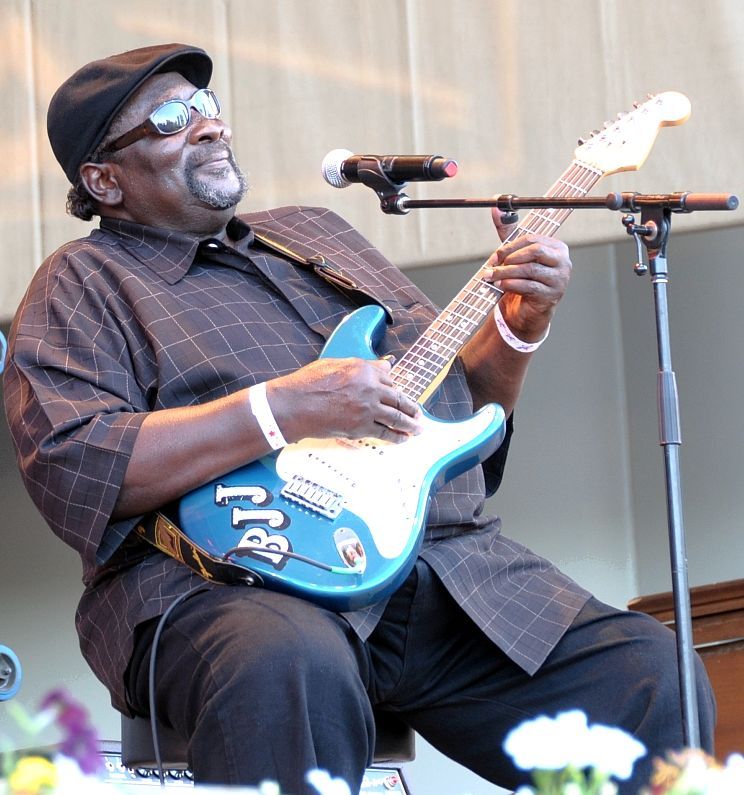
Born 1956, in Clarksville,Texas. Raised in Red River county, Texas, deep in the country of
northeast Texas. Early musical influences included the Memphis/Stax recording artists such
as Albert King, Wilson Pickett,Slim Harpo and Sam & Dave heard late at night on WLAC,Nashville,Tenn. A
guitar lesson with a travelin bluesman (believed to be ELMORE JAMES) passing thru DeKalb,
Texas(old stompin' grounds of LEADBELLY) at age 7 hooked him into the blues. Received first guitar at age 8, but wasn't very good at it. After finishing high school, joined
the U. S. Navy in 1975 & enlisted in the submarine service. After receiving christian conversion in 1980, suddenly received ability to play & compose blues & spirituals on guitar & harmonica (my father's instrument). Relocated to Cleveland, Ohio after leaving
the U. S. Navy in 1981 & begin performing part time for local gospel choirs, quartets & groups. Also played solo blues & gospel gigs. Became a ordained minister in the Holiness Church in 1995. Formed a Delta blues band, K. M. Williams & the Blues Train, in 1997. Gigs
included opening for ROBERT JR.LOCKWOOD,LITTLE MILTON,THE HOLMES BROTHERS & THE FIVE BLIND BOYS OF ALABAMA. Released one local cassette "Rollin'&Tumblin".
Relocated back to Texas (Dallas) in 1999.Begin performing solo blues gigs around Deep Ellum, Lower Greenville, Irving,& Arlington.Currently have released twenty-one internationally acclaimed CD's including 17 solo CD's starting with "THE REVEREND OF TEXAS COUNTRY BLUES(2000)";"TEXAS COUNTRY BLUES PREACHER(2001)";"SANCTIFED BOOGIE(2001)";"THE RETURN OF BROTHER LEMON(2002)(with Washboard Jackson on Percussion)",A dedication to BLIND WILLIE JOHNSON entitled"BLIND WILLIE'S HYMNS(2002)""I'M AN OLD SOUL(2003),"THE MINISTER OF TEXAS BOOGIE(2004)","COUNTRY ROADS,STREET CORNERS & CHURCH HOUSES"(2004),his first Label produced CD "THE BEST OF THE TEXAS COUNTRY BLUES PREACHER"(DWM MUSIC COMPANY - 2005),"TRUTH MUSIC"(2005),"THE RESURRECTION of BLIND WILLIE and OLD TIME SPIRITUALS"(2006),"HERE COMES THE PREACHER MAN"(2006),"LIVE WRECKAGE AND CLASSICS"(2007)(w Washboard Jackson),"THE LOST TAPES OF JUKES AND SPIRITUALS"(2007),"OLD SOUL/MINISTER OF TEXAS BOOGIE-REMASTERED,Snocap downloads only(2007)","LIVE AT THE LONGHORN BBQ"(2007)MORE WRECKAGE and CRIES FROM THE SOUL(2008).Also Formed a Rockin' Boogie/Blues duo with Texas Washboard Player and Percussionist WASHBOARD JACKSON called "TRAINRECK" and have since released four critically acclaimed CD's"THERE'S A TRAINRECK COMIN'(2003),"THE TRAIN KEEPS A'ROLLIN'(2004),"LIVE AT THE SCENE"(2005) and "11:59"(2006).Also have opened for or played on the same bill as KIM WILSON,WC CLARK,GARY CLARK JR.,ANDREW "JUNIOR BOY" JONES,ALVIN "YOUNGBLOOD" HART,ROBERT BELFOUR,RICHARD JOHNSTON,CEDELL DAVIS,DAVID "HONEYBOY" EDWARDS,JAMES MATHUS,and THE LEGENDARY MAVIS STAPLES. Two Documentaries was filmed on KM Williams & Trainreck;the first entitled"SANCTIFIED BOOGIE"(2004)based on the life of KM Williams which is currently available from Level Ground Films Productions & "A NITE IN A TRAINRECK"(2005)based on a typical night of performances following TRAINRECK(KM Williams & Washboard Jackson).Also released Music DVD'S entitled "KM WILLIAMS ;"LIVE AT THE LONGHORN BBQ"(DVD/2005)","LIVE IN ITALY(DVD/CD/2005) & "KM WILLIAMS & FRIENDS,LIVE IN SWITZERLAND"(2006)which are live performances.. As of the present,continues to Preach(started the SOUND GOSPEL BIBLE MINISTRIES in 2002),Sing & Play the Gospel and The Texas Country Blues/Boogie to anyone willing to listen, anywhere and anytime! Signed to Dialtone Records in Austin, TX on May 17th,2010.
Discover who's Playing on the Backporch at Rev. KM Williams' CountryBluesTown!
Friday, April 30, 2010
Tuesday, April 13, 2010
Elmo Williams & Hezekiah Early
Both Elmo Williams and Hezekiah Early are from Natchez, Mississippi. Hezekiah, formerly of Hezekiah and the House Rockers, is still the only man going who can simultaneously beat drums and blow through harmonica with the aid of electrician’s tape and a mike stand. Hezekiah has no competition - that must be nice.
Elmo, armed with a Yamaha guitar and a full Fender Band Master stack, does everything else. For Elmo, learning riffs has always come easy, as having respect for others, their beliefs, values, and personal property has always been difficult. The harder he tries to respect others, the harder it gets. Things would be a lot easier if he’s just give up. When not in church praying or playing guitar, Elmo mostly enjoys staying out of trouble.
Hezekiah loves busting big ol’ deer damn straight dead with his rifle both in, and out, of season. If he’s really bored he might eat some of it. He also enjoys driving his Thunderbird with the accelerator stomped all the way down. It makes him feel good about himself, grinding that floppy accelerator past where it should stop and into the carpet. This style of driving is Hezekiah’s way of giving something back to America, his own personal way of standing up for the rights of All-American men.
Don’t think for a second that these acts don’t go unnoticed. Ask anyone in Natchez - Hezekiah Early has a humdinger of a reputation.
- Matthew Johnson
Elmo, armed with a Yamaha guitar and a full Fender Band Master stack, does everything else. For Elmo, learning riffs has always come easy, as having respect for others, their beliefs, values, and personal property has always been difficult. The harder he tries to respect others, the harder it gets. Things would be a lot easier if he’s just give up. When not in church praying or playing guitar, Elmo mostly enjoys staying out of trouble.
Hezekiah loves busting big ol’ deer damn straight dead with his rifle both in, and out, of season. If he’s really bored he might eat some of it. He also enjoys driving his Thunderbird with the accelerator stomped all the way down. It makes him feel good about himself, grinding that floppy accelerator past where it should stop and into the carpet. This style of driving is Hezekiah’s way of giving something back to America, his own personal way of standing up for the rights of All-American men.
Don’t think for a second that these acts don’t go unnoticed. Ask anyone in Natchez - Hezekiah Early has a humdinger of a reputation.
- Matthew Johnson
Thursday, April 1, 2010
Boo Boo Davis
Boo Boo Davis is a survivor and belongs to the last generations of musicians that write and play the blues based on first hand experience of a hard life in the Mississippi Delta.He was born on November 4, 1943 in Drew, Mississippi. He started playing drums with his family band when he was seven years old. At that time he didn't have a drum kit so he used a lard can instead. This band, called the Lard Can Band, featured his father Sylvester sr. on vocals, his brother Sylvester jr. on bass, his younger brother John on guitar and his sister Clara also on vocals. His brother Sylvester jr is also known as S. L. Davis. This band played in Mississippi cities as Minnow City and Rulevine and during this time they also backed up young B.B. King who was at that time completely unknown outside Mississippi.
. It was the richest cotton land in the South and the large amounts of field workers attracted the best musicians from the surrounding areas. The entire Delta region was rich with blues, but the town of Drew was a particularly fertile one. Charley Patton stayed near Drew for many years and several legendary performers spent time there. Sharecroppers sang loudly to help pass the grueling hours of work and without a doubt Boo Boo developed his loud, bellowing voice based on the singing he heard in the fields as a young boy. In fact, that voice, through the years has demolished many amps and speaker cabinets.
Boo Boo's father, Sylvester Davis farmed cotton and played several instruments. Musicians who he played with include John Lee Hooker, Elmore James and Robert Pete Williams. Boo Boo remembers these and other musicians dropping by and rehearsing at their house. At the age of five Boo Boo was playing the harmonica and singing in church with his mother. By thirteen he was playing guitar, and by eighteen he was playing out with his father and older brothers under the name of The Lard Can Band. This band travelled all throughout the Delta. In the early sixties he went north to St Louis and was around during the heyday of the St Louis music scene (Albert King, Ike Turner, Chuck Berry and many others). Together with his brothers they were the weekend house band in Tabby's Red Room in East St Louis for eighteen years.
Even though Boo Boo moved north to St. Louis, he will always be a southerner at heart. When he is at home (and not performing) his favorite pastimes are hunting with his dogs and fishing. During Boo Boo's childhood there was no time or money for him to go to school so he never learned to read and write. However that did not prevent him to travel all over the world. Following his guiding spirit (that he calls Dave) Boo Boo has found a way to deal with modern society. The blues helps him to keep his spirit high and survive day-to-day life. It deals with all the basic raw elements of life; good and bad, plain and simple.
His first European tour took place in April 2000 and since then Boo Boo is touring Europe at least twice a year. So far Boo Boo has released 5 CD's on Black and Tan Records and all of them were very well received. Number 4 (DREW, MISSISSIPPI) was listed with the 10 best blues records of 2006 by MOJO Magazine (UK). In 2007 Boo Boo was invited to perform on the POCONO BLUES FESTIVAL, one of the biggest blues festivals in the USA and in March 2007 Boo Boo performed live on CBC Radio One, national radio in Canada. What started as a crazy idea after the European tour of Boo Boo in October 2007 has turned out to be not too crazy at all. On the Spring Tour of 2008 they decided to leave out the bass and tour as a trio (Boo Boo + drums & guitar). In June 2008 they went into the studio and the CD (NAME OF THE GAME) was released in September 2008.
In the summer of 2009 the trio played a string of big blues & jazz festivals all over Europe. During those long travels they got a lot of ideas for new songs. So in the middle of the tour they went into the studio for two days and recorded a new record (AIN'T GOTTA DIME). All songs were played live in the studio without any overdubs and for most songs the first take turned out to be the best one. This is exactly how they sound live. Unlike many modern blues bands, Boo Boo and his band focus on the groove, the feel, and the basic truths found in the blues. Blues doesn't come any 'realer' than this.
Monday, March 8, 2010
Barbecue Bob
Robert Hicks, better known as Barbecue Bob (September 11, 1902 – October 21, 1931) was an early American country blues musician. His nickname came from the fact that he was a cook in a barbecue restaurant. One of the two extant photographs of Bob show him playing his guitar while wearing a full length white apron and cook's hat.He was born in Walnut Grove, Georgia. He and his brother, Charlie Hicks, together with Curley Weaver, were taught how to play the guitar by Curley's mother, Savannah "Dip" Weaver. Bob began playing the 6-string guitar but picked up the 12-string guitar after moving to Atlanta, Georgia in 1923-1924. He became one of the prominent performers of the newly developing early Atlanta blues style.
In Atlanta, Hicks worked a variety of jobs, playing music on the side. While working at Tidwells' Barbecue in a north Atlanta suburb, Hicks came to the attention of Columbia Records talent scout Dan Hornsby. Hornsby recorded him and decided to use Hicks's job as a gimmick, having him pose in chef's whites and hat for publicity photos and dubbing him "Barbecue Bob".During his short career he recorded 68 78-rpm sides. He recorded his first side, "Barbecue Blues", in March 1927. The record quickly sold 15,000 copies and made him the best selling artist for Columbia up to that date. Despite this initial success, it was not until his second recording session, in New York during June 1927, that he firmly established himself on the race market. At this session he recorded "Mississippi Heavy Water Blues", a song inspired by the major floods taking place in Mississippi at that time. This song, as well as his other blues releases, gained considerable popularity, and his records sold much better than those of other local blues musicians.Bob developed a "flailing" or "frailing" style of playing guitar more often associated with the traditional clawhammer banjo (as did his brother, and, initially, Curley Weaver). He used a bottleneck regularly on his 12-string guitar, playing in an elemental style that relied on an open Spanish tuning reminiscent of Charley Patton. He had a strong voice that he embellished with growling and falsetto, and a percussive singing style.
The two part duet with crosstalk, "It Won't Be Long Now" was recorded with his brother Charlie (a/k/a Charlie Lincoln, or Laughing Charlie) in Atlanta on 5 November 1927. In April 1928 Bob recorded two sides with the female vocalist Nellie Florence, whom he had known since childhood, and also produced "Mississippi Low Levee Blues", a sequel to "Mississippi Heavy Water Blues". In April 1930, he recorded "We Sure Got Hard Times Now", which contains bleak references to the early effects of The Depression. Although Barbecue Bob remained predominantly a blues musician, he also recorded a few traditional and spiritual songs including "When the Saints Go Marching In", "Poor Boy, Long Ways from Home" and "Jesus' Blood Can Make Me Whole".
Barbecue Bob also recorded as a member of The Georgia Cotton Pickers in December 1930, a group that included guitarist Curley Weaver and harmonica player Buddy Moss. As a group they recorded a handful of sides including their own adaptation of Blind Blake's "Diddie Wa Diddie" (recorded as "Diddle-Da-Diddle") and the Mississippi Sheiks' "Sitting on Top of the World" (recorded as "I'm On My Way Down Home"). These were the last recordings that Bob recorded.He died in Lithonia, Georgia, of a combination of tuberculosis and pneumonia brought on by influenza, at the age of 29, on October 21, 1931. His recording of "Mississippi Heavy Water Blues"(about the 1927 flood) was apparently played at his graveside before burial.
Bob had some influence on Atlanta blues musicians such as the young Buddy Moss (who played harmonica with him on The Georgia Cotton Pickers recordings), but his way of playing was quickly overshadowed by the finger-picked Piedmont blues style that rose in popularity by the late 20s/early 30s as can be heard in the development of the recordings of Curley Weaver. Barbecue Bob's "Motherless Child Blues" was recorded and performed on stage by Eric Clapton.
In Atlanta, Hicks worked a variety of jobs, playing music on the side. While working at Tidwells' Barbecue in a north Atlanta suburb, Hicks came to the attention of Columbia Records talent scout Dan Hornsby. Hornsby recorded him and decided to use Hicks's job as a gimmick, having him pose in chef's whites and hat for publicity photos and dubbing him "Barbecue Bob".During his short career he recorded 68 78-rpm sides. He recorded his first side, "Barbecue Blues", in March 1927. The record quickly sold 15,000 copies and made him the best selling artist for Columbia up to that date. Despite this initial success, it was not until his second recording session, in New York during June 1927, that he firmly established himself on the race market. At this session he recorded "Mississippi Heavy Water Blues", a song inspired by the major floods taking place in Mississippi at that time. This song, as well as his other blues releases, gained considerable popularity, and his records sold much better than those of other local blues musicians.Bob developed a "flailing" or "frailing" style of playing guitar more often associated with the traditional clawhammer banjo (as did his brother, and, initially, Curley Weaver). He used a bottleneck regularly on his 12-string guitar, playing in an elemental style that relied on an open Spanish tuning reminiscent of Charley Patton. He had a strong voice that he embellished with growling and falsetto, and a percussive singing style.
The two part duet with crosstalk, "It Won't Be Long Now" was recorded with his brother Charlie (a/k/a Charlie Lincoln, or Laughing Charlie) in Atlanta on 5 November 1927. In April 1928 Bob recorded two sides with the female vocalist Nellie Florence, whom he had known since childhood, and also produced "Mississippi Low Levee Blues", a sequel to "Mississippi Heavy Water Blues". In April 1930, he recorded "We Sure Got Hard Times Now", which contains bleak references to the early effects of The Depression. Although Barbecue Bob remained predominantly a blues musician, he also recorded a few traditional and spiritual songs including "When the Saints Go Marching In", "Poor Boy, Long Ways from Home" and "Jesus' Blood Can Make Me Whole".
Barbecue Bob also recorded as a member of The Georgia Cotton Pickers in December 1930, a group that included guitarist Curley Weaver and harmonica player Buddy Moss. As a group they recorded a handful of sides including their own adaptation of Blind Blake's "Diddie Wa Diddie" (recorded as "Diddle-Da-Diddle") and the Mississippi Sheiks' "Sitting on Top of the World" (recorded as "I'm On My Way Down Home"). These were the last recordings that Bob recorded.He died in Lithonia, Georgia, of a combination of tuberculosis and pneumonia brought on by influenza, at the age of 29, on October 21, 1931. His recording of "Mississippi Heavy Water Blues"(about the 1927 flood) was apparently played at his graveside before burial.
Bob had some influence on Atlanta blues musicians such as the young Buddy Moss (who played harmonica with him on The Georgia Cotton Pickers recordings), but his way of playing was quickly overshadowed by the finger-picked Piedmont blues style that rose in popularity by the late 20s/early 30s as can be heard in the development of the recordings of Curley Weaver. Barbecue Bob's "Motherless Child Blues" was recorded and performed on stage by Eric Clapton.
Monday, March 1, 2010
Doctor Ross, the harmonica boss
Doctor Ross, the harmonica boss, was an American blues singer, guitarist, harmonica player and drummer — a one-man band[2] — who was born Charles Isaiah Ross, in Tunica, Mississippi.Ross played various forms of the blues that have seen him compared to John Lee Hooker and Sonny Boy Williamson I, and is perhaps best known for the recordings he made for Sun Records in the 1950s, notably "The Boogie Disease" and "Chicago Breakdown".In 1951 Ross began to be heard on Mississippi and Arkansas radio stations, now nicknamed Doctor because of his habit of carrying his harmonicas in a black bag that resembled a doctor's bag. Over the next three years he recorded in Memphis, Tennessee for both Chess and Sun, creating exhilarating harmonica or guitar boogies made distinctive by his sidemen playing washboard (with a spoon and fork) and broom.In 1954 Ross took a job with General Motors in Flint, Michigan, and reduced his playing. He released a string of 45s on the Detroit-based Fortune Records. Some singles, among them his first true one-man band effort, "Industrial Boogie", filtered into blues circles, leading to a Testament Records album and a 1965 American Folk Blues Festival booking in Europe.While in London he recorded what would be the first LP on Blue Horizon Records. In 1972 he recorded for Ornament Records during a German tour. Europe loved Ross and gave him work and recording opportunities; he was never as popular at home, and in the 1980s his performing profile was barely visible.
Ross won a Grammy for his 1981 LP Rare Blues, and subsequently enjoyed a resurgence of popularity and critical acclaim towards the end of his career.
He died in 1993, at the age of 67, and was buried in Flint, Michigan.
Ross won a Grammy for his 1981 LP Rare Blues, and subsequently enjoyed a resurgence of popularity and critical acclaim towards the end of his career.
He died in 1993, at the age of 67, and was buried in Flint, Michigan.
Wednesday, February 10, 2010
Big Jack Johnson "The Oilman"
Big Jack Johnson (born July 30, 1940, Lambert, Mississippi, United States.Johnson's father was a local musician playing both blues and country ditties at local functions. At the age of 13, Johnson junior was playing guitar with his father's band. By 18, Johnson followed B.B. King's electrified lead. His break came when he sat in with Frank Frost and Sam Carr at the Savoy Theatre in Clarksdale, Mississippi. The trio were seldom apart for the next 15 years, recording for Phillips International and Jewel Records with Frost as the bandleader.
In 1979, Rockin' the Juke Joint Down, was released (as by the Jelly Roll Kings) and marked Johnson's first recordings as a singer. Johnson's subsequent 1987 album for Earwig Records, The Oil Man, included his recording of "Catfish Blues." He has recorded both solo and as a member of the blues groups the Jelly Roll Kings and Big Jack Johnson and the Oilers (with poet/musician Dick Lourie).He performed and wrote "Jack's Blues" and performed "Catfish Medley" with Samuel L. Jackson on the Black Snake Moan, film soundtrack,"Daddy, When Is Mama Comin Home?" his ambitious 1990 set for Earwig, found him tackling issues as varied as AIDS, wife abuse, and Chinese blues musicians.
Tuesday, February 2, 2010
CeDell Davis
CeDell Davis (born Ellis Davis, 9 June 1927, Helena, Arkansas) is a blues guitarist and singer.Davis is most notable for his distinctive style of guitar playing. Davis plays guitar using a table knife in his fretting hand in a manner similar to slide guitar, resulting in a welter of metal-stress harmonic transients and a singular tonal plasticity. He uses this style out of necessity. When he was 10, he suffered from severe polio which left him little control over his left hand and restricted use of his right. He had been playing guitar prior to his polio and decided to continue in spite of his handicap, and developed his knife method as the only way he could come up with of still playing guitar.
Davis was born in Helena, where his family worked on a local plantation. He enjoyed music from a young age, playing harmonica and guitar with his childhood friends.Once he sufficiently mastered his variation on slide guitar playing, Davis began playing in various nightclubs across the Mississippi Delta area. He played with Robert Nighthawk for a ten year period from 1953 to 1963. While playing in a club in 1957, a police raid caused the crowd to stampede over Davis. Both of his legs were broken in this incident and he was forced to use a wheelchair from then on. The hardships resulting from his physical handicaps were a major influence in his lyrics and style of blues playing.
In recent times, Davis' music has been released by the Fat Possum Records label to much critical acclaim. His 1994 album, produced by Robert Palmer, Feel Like Doin' Something Wrong, received a 9.0 from Pitchfork Media who called it "timeless."
The Best Of CeDell Davis (1995) was also released, with help from Col. Bruce Hampton and The Aquarium Rescue Unit. The Horror of It All followed in 1998. Davis took time away from recording after these releases, and spent the next four years writing and performing. When he returned to the recording studio, he drafted musicians like R.E.M.'s Peter Buck, R.E.M. sideman Scott McCaughey, The Screaming Trees' Barrett Martin, and soul keyboardist Alex Veley. The final results, When Lightnin' Struck the Pine, was released in 2002.
Subscribe to:
Posts (Atom)