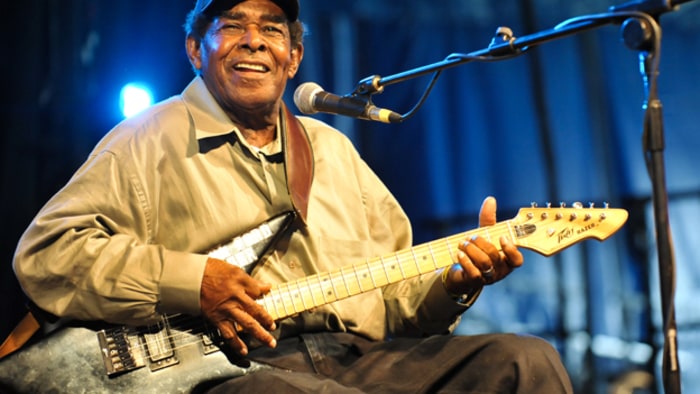
Robert Pete Williams (March 14, 1914 – December 31, 1980) was an American Louisiana blues musician, based in Louisiana. His music characteristically employs unconventional blues tunings and structures, and his songs are often about the time he served in prison. His song "I've Grown So Ugly" has been covered by Captain Beefheart, on his album Safe as Milk (1967), and by The Black Keys, on Rubber Factory (2004).
Williams was born in Zachary, Louisiana to sharecropping parents, and lived around the Baton Rouge area throughout his life.[1] He was discovered in Angola prison, by ethnomusicologists Dr Harry Oster and Richard Allen, where he was serving a life sentence for shooting a man dead in a local club in 1956, an act which he claimed was in self-defense.“...the most avant-garde blues performer ever recorded. No punk rock band has ever matched the jagged, acerbic fury of the riffs Williams played 35 years ago. No rapper has approached his ability to evoke the torment of life in prison or bend language to cast an eerie spell over a chance encounter with a seductive woman.... He had never been recorded when he was discovered in Angola Penitentiary in Louisiana, convicted of murder. Oster and Allen recorded Williams performing several of his songs about life in prison and pleaded for him to be pardoned. The pardon was partially granted in 1959, when Williams was released, although he could not leave Louisiana until he received a full pardon in 1964. By this time, Williams' music had achieved some favorable word-of-mouth reviews, and he played his first concert outside Louisiana at that year's Newport Folk Festival. Williams went on to tour the United States, and played a number of concerts with Mississippi Fred McDowell. He continued to play concerts and festivals into the late 1970s when his health began to decline. His most popular recordings included "Prisoner's Talking Blues" and "Pardon Denied Again".Williams has been inducted into the Louisiana Blues Hall of Fame. Williams died in Rosedale, Louisiana on 31 December 1980, at the age of 66.
RUBIN ''RUBE'' LACY BIOGRAPHY: (born January 2, 1901, Pelahatchie, Miss.; died c. 1972, Bakersfield, CA) An important influence on blues great SON HOUSE, Rubin Lacy was part of the Jackson, Mississippi, blues scene in the 1920s -- a scene that also included ISHMAN BRACEY, TOMMY JOHNSON, and CHARLIE MCCOY. LaCY recorded only two sides during his career as a bluesman, but his chiseled vocals and rummaging guitar style played a role in the early development of Delta blues. Lacy was raised by his grandfather, a preacher. After learning how to play guitar, he left home and worked Mississippi juke joints. He drifted as far north as Illinois in the mid-1920s before returning to the Jackson area, where he frequently performed with the above-mentioned blues musicians and the popular Chatmon family. His two recordings --- ''Mississippi Jail House Groan'' and ''Ham Hound Crave'' --- were cut for Paramount in 1928, although he reputedly played on a number of other recordings made by Mississippi bluesmen. Sometime around 1932 Lacy quit the blues and became a Baptist minister. For the next two decades he preached in Mississippi churches. In the late 1950s Lacy moved to Los Angeles, and later settled in Bakersfield, where he died in or around 1972. -- by Robert Santelli
Tommy Johnson (1896 – November 1, 1956) was an influential American delta blues musician who recorded in the late 1920s, known for his eerie falsetto voice and intricate guitar playing. Johnson was born near Terry, Mississippi, and moved around 1910 to Crystal Springs where he lived for most of his life. He learned to play the guitar and, by 1914, was supplementing his income by playing at local parties with his brothers Mager and LeDell. In 1916 he married and moved to Webb Jennings' Plantation near Drew, Mississippi, close to the Dockery Plantation. There he met other musicians including Charlie Patton and Willie Brown.By 1920 he had become an alcoholic and itinerant musician, based in Crystal Springs but travelling widely around the South, sometimes accompanied by Papa Charlie McCoy. In 1928 he made his first recordings with McCoy for Victor Records. The recordings included "Canned Heat Blues", in which he sang of drinking methanol from the cooking fuel Sterno. The song features the refrain "canned heat, mama, sure, Lord, killing me." The blues group Canned Heat took their name from this song. Johnson's "Big Road Blues" inspired Canned Heat's song, "On the Road Again". A significantly different version of the song appears as "Canned Heat" on the Big Road Blues album by K. C. Douglas. He recorded two further sessions, in August 1928 and for Paramount Records in December 1929. He did not record again, mistakenly believing that he had signed away his right to record . This resulted on a legal settlement with The Mississippi Sheiks who had used Johnson's 'Big Road Blues' melody in their enormously successful "[Stop and Listen]". Johnson was party to the copyright settlement, but was too drunk at the time to understand what he had signed to. Johnson's recordings established him as the premier Delta blues vocalist of his day, with a powerful voice that could go from a growl to a falsetto. He was also an accomplished guitarist. His style influenced later blues singers such as Robert Nighthawk and Howlin' Wolf, whose song "I Asked for Water (She Brought Me Gasoline)" was based on Johnson's "Cool Water Blues". He was a talented composer, blending fragments of folk poetry and personalized lyrics into set guitar accompaniments to craft striking blues compositions such as "Maggie Campbell.To enhance his fame, Johnson cultivated a sinister persona. According to his brother LeDell, he claimed to have sold his soul to the devil in exchange for his mastery of the guitar. This story was later also associated with Robert Johnson, to whom he was unrelated. Tommy Johnson also played tricks with his guitar, playing it between his legs and behind his head, and throwing it in the air while playing. Johnson remained a popular performer in the Jackson area through the 1930s and 1940s, sometimes performing with Ishman Bracey. He was highly influential on other performers, partly because he was willing to teach his style and his repertoire.He died of a heart attack after playing a party in 1956. He is buried in the Warm Springs Methodist Church Cemetery outside of Crystal Springs, Mississippi. In 2001 a headstone was commissioned through the Mt. Zion Memorial Fund, a Mississippi non-profit corporation, by the family of Tommy Johnson and paid for by musician Bonnie Raitt.
J. B. Hutto (April 26, 1926 - June 12, 1983[1]) was an American blues musician, born Joseph Benjamin Hutto. Hutto was heavily influenced by legendary bluesman Elmore James, and became known for his slide guitar work and declamatory style of singing. He was inducted into the Blues Hall of Fame two years after his death.Hutto was born in Blackville, South Carolina, the fifth of seven children. His family moved to Augusta, Georgia, when Hutto was three years old. His father, Calvin, was a preacher, and Hutto, along with his three brothers and three sisters, formed a gospel group called The Golden Crowns, singing in local churches. Hutto's father died in 1949, and the family relocated to Chicago. Hutto served as a draftee in the Korean War in the early 1950s, driving trucks in combat zones. In Chicago, Hutto took up the drums and played with Johnny Ferguson and his Twisters. He also tried the piano before settling on the guitar, and playing on the streets with percussionist Eddie 'Porkchop' Hines. After adding Joe Custom on second guitar they started playing club gigs, and harmonica player George Mayweather joined after sitting in with the band. Hutto named his band The Hawks, after the wind that blows in Chicago. A recording session in 1954 resulted in the release of two singles on the Chance label, and a second session later the same year, with the band supplemented by pianist Johnny Jones, produced a third. Later in the 1950s Hutto became disenchanted with music and gave it up to work as an undertaker after a woman broke his guitar over her husband's head one night.[6] He returned to music in the mid 1960s with a new version of the Hawks featuring Herman Hassell on bass and Frank Kirkland on drums.[7] His recording career resumed with, first, a session for Vanguard Records released on the compilation album Chicago/the Blues/Today! Vol. 1, and then albums for Testament and Delmark.[8] After Hound Dog Taylor died in 1975, Hutto took over his band the Houserockers for a time, and in the late 1970s he moved to Boston and recruited a new band which he called the New Hawks, with whom he recorded further studio albums for the Varrick label.J.B.'s music remains the epitome of intense electrified urban Chicago blues, J.B.'s music and influence range from Big Bill Broonzy to Muddy Waters. Moreover, J.B.'s boogie and rollicking style draw comparisons to Fats Domino and Bo Diddley. J.B. did not possess the musical polish that other musicians had, nor did he have the business acumen or experience the popularity of some of his contemporaries. J.B., did possess an instantly recognizable, moving and emotional slide guitar and vocal that could bring a crowded bar room to a halt.Hutto returned to Illinois in the early 1980s, where he was diagnosed with cancer. He died in 1983, at the age of 57, in Harvey, Illinois. He was interred at the Restvale Cemetery, Alsip, Cook County, Illinois. In 1985 the Blues Foundation inducted Hutto into its Hall of Fame.[10] His nephew, Lil' Ed Williams (of Lil' Ed and the Blues Imperials) has carried on his legacy, playing and singing in a style very close to his uncle.
Today is The Birthday of Charlie Patton kown as "Charley Patton" considered the father of Delta Blues. "Charley Patton (May 1, 1891 – April 28, 1934) is best known as an American Delta blues musician. He is considered by many to be the "Father of Delta Blues" and therefore one of the oldest known figures of American popular music. He is credited with creating an enduring body of American music and personally inspiring just about every Delta blues man (Palmer, 1995). Musicologist Robert Palmer considers him among the most important musicians that America produced in the twentieth century. Many sources, including musical releases and his gravestone,[1] spell his name “Charley” even though the musician himself spelled his name "Charlie."Charlie Patton was one of the first mainstream stars of the Delta blues genre. Patton, who was born in Hinds County, Mississippi near Edwards, lived most of his life in Sunflower County, in the Mississippi Delta. Most sources say he was born in 1891, but there is some debate about this, and the years 1887 and 1894 have also been suggested. In 1900, his family moved 100 miles north to the legendary 10,000-acre Dockery Plantation sawmill and cotton farm near Ruleville, Mississippi. It was here that both John Lee Hooker and Howlin' Wolf fell under the Patton spell. It was also here that Robert Johnson played and was given his first guitar. At Dockery, Charlie fell under the tutelage of Henry Sloan, who had a new, unusual style of playing music which today would be considered very early blues. Charlie followed Henry Sloan around, and, by the time he was about 19, had become an accomplished performer and songwriter in his own right, having already composed "Pony Blues," a seminal song of the era. Robert Palmer describes Patton as a "jack-of all-trades bluesman" who played "deep blues, white hillbilly songs, nineteenth century ballads, and other varieties of black and white country dance music with equal facility". He was extremely popular across the Southern United States, and — in contrast to the itinerant wandering of most blues musicians of his time — played scheduled engagements at plantations and taverns. Long before Jimi Hendrix impressed audiences with flashy guitar playing, Patton gained notoriety for his showmanship, often playing with the guitar down on his knees, behind his head, or behind his back. Although Patton was a small man at about 5 foot 5 and 135 pounds, his gravelly voice was rumored to have been loud enough to carry 500 yards without amplification. Patton's gritty bellowing was a major influence on the singing style of his young friend Chester Burnett, who went on to gain fame in Chicago as Howlin' Wolf.Patton's ethnicity is the subject of minor debate. Though he was considered African-American, because of his light complexion there have been rumors that he was Mexican, or possibly a full-blood Cherokee, a theory endorsed by Howlin' Wolf. In actuality, Patton was a mix of white, black, and Cherokee (one of his grandmothers was a full-blooded Cherokee). Patton himself sang in "Down the Dirt Road Blues" of having gone to "the Nation" and "the Territo'" -- meaning the Cherokee Nation portion of the Indian Territory (which became part of the state of Oklahoma in 1907), where a number of Black Indians tried unsuccessfully to claim a place on the tribal rolls and thereby obtain land. Patton settled in Holly Ridge, Mississippi with his common-law wife and recording partner Bertha Lee in 1933. He died on the Heathman-Dedham plantation near Indianola from heart disease on April 28, 1934 and is buried in Holly Ridge (both towns are located in Sunflower County). A memorial headstone was erected on Patton's grave (the location of which was identified by the cemetery caretaker C. Howard who claimed to have been present at the burial) paid for by musician John Fogerty through the Mt. Zion Memorial Fund in July, 1990."
Elmore James (January 27, 1918 – May 24, 1963) was an American blues guitarist, singer, song writer and band leader. He was known as "The King of the Slide Guitar" and had a unique guitar style, noted for his use of loud amplification and his stirring voice.James was born Elmore Brooks in the old Richland community in Holmes County, Mississippi (not to be confused with two other locations of the same name in Mississippi, one in Humphreys County and the other in Rankin County). He was the illegitimate son of 15-year-old Leola Brooks, a field hand. His father was probably Joe Willie "Frost" James, who moved in with Leola, and so Elmore took this as his surname. His parents adopted an orphaned boy, Robert Holston, at some point. Elmore began making music at age 12 using a simple one-string instrument ('diddley bow' or 'jitterbug') strung up on a shack wall. As a teen he was playing at local dances under the names "Cleanhead" and "Joe Willie James." Other well-known musicians of that time with whom he played included the "second"' Sonny Boy Williamson and the legendary Robert Johnson. (There is a dispute as to whether Robert Johnson or Elmore wrote James's trademark song, "Dust My Broom".[1]. Elmore was still under 20 when Johnson had recorded his version of the song.) Although Johnson died in 1938, James (like many other musicians) was strongly influenced by him, and also by Kokomo Arnold and Tampa Red. Elmore recorded several of Tampa Red's songs, and even inherited from his band two of his famous "Broomdusters", 'Little' Johnny Jones (piano) and Odie Payne (drums). An important side to Elmore's character which may have hastened his demise was his lifelong taste for, and manufacture of, moonshine whiskey, to which he was introduced at an early age. Alcohol killed his bandmates and friends Willie Love and Johnny Jones at an early age, and probably others too. His regular rhythm guitarist Homesick James maintained his longevity was due to his not partaking of the heavy drinking sessions after — and often during — gigs, a refusal that was unpopular with the rest of the band. Elmore was also reportedly an extremely fast driver who also loved hunting with guns and dogs down in Mississippi, whence he would head off for protracted periods. During World War II James joined the United States Navy, was promoted to coxswain and took part in the invasion of Guam against the Japanese. Upon his discharge, Elmore returned to central Mississippi and eventually settled in Canton with his adopted brother Robert Holston, it was at this time he learned that he had a serious heart condition. Working in Robert's electrical shop he devised his unique electric sound, using parts from the shop and an unusual placement of two D'Armond pick ups.[1] He began recording with Trumpet Records in nearby Jackson in January 1951, first as sideman to the second Sonny Boy Williamson and also to their mutual friend Wille Love and possibly others, then debuting as a session leader in August with "Dust My Broom". It was a surprise R&B hit in 1952 and turned James into a star. He then broke his contract with Trumpet Records to sign up with the Bihari Brothers through Ike Turner (who played guitar and piano on a couple of his early Bihari recordings). James' "I Believe" was another hit a year later. During the 1950s he recorded for the Bihari Brothers' Flair Records, Meteor Records and Modern Records labels, as well as for Chess Records and Mel London's Chief Records for whom "It Hurts Me Too" was a hit. His backing musicians were known as the Broomdusters. In 1959 he began recording what are perhaps his best sides for Bobby Robinson's Fire Records label. These include "The Sky Is Crying" (credited to Elmo James and His Broomdusters), "My Bleeding Heart", "Stranger Blues", "Look On Yonder Wall", "Done Somebody Wrong", and "Shake Your Moneymaker", all of which are among the most famous of blues recordings.James played a wide variety of blues (which often crossed over into other styles of music) similar to that of Muddy Waters, Howlin' Wolf and some of B. B. King's work, but distinguished by the powerful sound coming from a modified hollow-bodied traditional acoustic guitar. He most often played using a slide, but on several recordings he plays without. His voice and style was as instantly recognizable as B. B.'s, Muddy's and Wolf's and, until he fell afoul of the Chicago union, he and his Broomdusters were as popular in the Chicago clubs as any of these musicians' bands. Muddy Waters took the Belgian blues fan (Georges Adins) to see Elmore play in Chicago in 1959, Adins recalled, "Elmore will always remain the most exciting, dramatic blues singer and guitarist that I've ever had a chance to see perform in the flesh. On our way we listened to him on the radio as Big Bill Hill ... was broadcasting direct from that place. I was burning to see Elmore James and before we even pushed open the door of the club, we could hear Elmore's violent guitar sound. Although the place was overcrowded, we managed to find a seat close to the bandstand and the blues came falling down on me as it had never done before. Watching Elmore sing and play, backed by a solid blues band (Homesick James, J.T. Brown, Boyd Atkins and Sam Cassell) made me feel real fine. Wearing thick glasses, Elmore's face always had an expressive and dramatic look, especially when he was real gone on the slow blues. Singing with a strong and rough voice, he really didn't need a mike. On such slow blues as "I'm Worried - "Make My Dreams Come True" - "It Hurts Me", his voice reached a climax and created a tension that was unmistakably the down and out blues. Notwithstanding that raw voice, Elmore sang his blues with a particular feeling, an emotion and depth that showed his country background. His singing was... fed, reinforced by his own guitar accompaniment which was as rough, violent and expressive as was his voice. Using the bottleneck technique most of the time, Elmore really let his guitar sound as I had never heard a guitar sound before. You just couldn't sit still! You had to move..." Most electric slide guitar players will admit to the massive influence of James' style.[citation needed] He was also a major influence on successful blues guitarists as Homesick James (Elmore's older cousin who was a member of Elmore's band The Broomdusters since 1957 and featured on many of his recordings), John Littlejohn, Hound Dog Taylor, J.B. Hutto and many others. He also influenced many rock guitarists such as The Rolling Stones' Brian Jones and Fleetwood Mac's Jeremy Spencer.Elmore James' songs "Done Somebody Wrong" and "One Way Out" were covered by The Allman Brothers Band, who cited him as a major influence. James was also covered by blues-rock band Stevie Ray Vaughan and Double Trouble many times in concert. The most famous of these covers is one that came by an indirect route: James' fellow bluesman Albert King recorded a cover of "The Sky Is Crying", and Stevie Ray Vaughan copied King's version of the song. That song was also covered by George Thorogood on his second album, Move It On Over and by Eric Clapton .Perhaps the most famous guitarist who admired Elmore James was Jimi Hendrix. Early in Hendrix's career, he styled himself variously as 'Maurice James' and subsequently as 'Jimmy James'. This, according to former band mate and recording partner Lonnie Youngblood, was a tribute to Elmore James. Elmore James died of his third heart attack in Chicago, Illinois in 1963, just prior to a tour of Europe with that year's American Folk Blues Festival. He is buried in the Newport Baptist Church Cemetery, Ebenezer, Holmes County, Mississippi.
Weldon H. Philip Bonner, better known as Juke Boy Bonner (22 March 1932 — 29 June 1978[1]) was an American blues singer, harmonica player, and guitarist. He was influenced by Lightnin' Hopkins, Jimmy Reed, and Slim Harpo. He described the bleak prospects of black urban existence in songs like "Life is a Nightmare", "Struggle Here in Houston" and "Going Back to the Country", accompanying himself on guitar, harmonica and drums in the self sufficient one-man band mode of Joe Hill Louis and Dr. Ross.[2]Born in Bellville, Texas, Bonner was one of nine children; his parents died while he was very young, and he was raised by a neighbour's family, and later, he moved in with his older sister in 1945. At the age of twelve he taught himself the guitar.[1] He gained the nickname "Juke Boy" as a youth, as he frequently sang in local bars accompanied by the juke box. Starting a musical career as teenager, he won the first prize at local disc jockey Trummie Cain's weekly talent show at the Lincoln Theater in Houston, Texas in 1948. Through this he secured a 15 minute radio slot on a show operated by record retailer Henry Atlas. After having three children with his wife, she left him to look after the children by himself.
Between 1954 and 1957 he recorded several singles for the Oakland, California based Irma record label, but not all were released at the time. In 1960 he recorded again, this time for the Goldband Records, Storyville Records, and Jan & Dill Records labels. In 1963 he was diagnosed with a large stomach ulcer, and had to have almost half of his stomach removed in surgery. The shock of this operation, plus the social climate of the times (which included civil rights riots and the assassination of President John F. Kennedy) led Bonner to begin writing poetry, some of which was published in the Forward Times weekly newspaper. Recovering from surgery, Bonner worked as an RCA record distributor in Houston. Once his strength returned he began playing gigs again in the local area.
In 1967 Bonner recorded his first album for the Flyright label. Chris Strachwitz's Arhoolie label released two albums, I'm Going Back to The Country (1968) and The Struggle (1969) (Arhoolie would later issue some of Bonner's unreleased 1967-1974 recordings on 2003's Ghetto Poet). Bonner recorded mostly original song material through his recording career. He was a guest at the Ann Arbor Blues Festival, the American Folk Blues Festival, and the Montreux Blues and Rock Festival. In 1972 he released an LP for Sonet Records, and in 1975 another one for the Houston based Home Cooking Records label. However, Bonner was not able to support himself from his music due to little demand for his work. Although he would continue to play and record sporadically, he had no choice but to take a minimum wage job at a chicken processing plant in Houston.[1]
Bonner died in his apartment in 1978, aged forty-six, of cirrhosis of the liver.
I am a real life Texas Country Bluesman & Minister of the Gospel.I have also released eighteen critically acclaimed blues CD's & one DVD/CD Combo of my own,including","The Reverend of Texas Country Blues","Texas Country Blues Preacher","Sanctified Boogie","The Return of Brother Lemon","Blind Willie's Hymns","I'm an Old Soul","The Minister of Texas Boogie","Country Roads,Street Corners and Church Houses";"Truth Music";My first DVD/CD combo"Live in Italy";"The Resurrection of Blind Willie and Old Time Spirituals", "Here Comes The Preacher Man" "Live Wreckage and Classics" ,"The Lost Tapes Of Jukes And Spirituals""Live at the Longhorn BBQ","Cries From the Soul" ,"More Wreckage" "The Boogie Reverend" and "TexasMississippi Blues Spirituals".