Discover who's Playing on the Backporch at Rev. KM Williams' CountryBluesTown!
Thursday, May 3, 2012
Tuesday, April 17, 2012
Elmo Williams & Hezekiah Early [Bigged legged woman]
My Distance relative is Elmo Williams, a Raw,Authentic Bluesman from Natchez, MS! Enjoy some real modern blues - Rev KM Williams
Tuesday, April 3, 2012
The Heritage Blues Orchestra
THE HERITAGE BLUES ORCHESTRA IS:
Chaney Sims: vocals, handclaps
Bill Sims, Jr.: vocals, electric and acoustic guitars, handclaps
Junior Mack: vocals, electric and electric slide guitars, dobro
Vincent Bucher: harmonica. Listen to their debut album, or witness a live performance by the Heritage Blues Orchestra and you'll recognize this group as something breathtakingly new even as they honor old African-American musical traditions. How can something so deeply rooted in the past still seem so adventurous-even audacious?
Heritage Blues Orchestra delivers by serving up a compelling new take on America's Blues legacy. This utterly contemporary group is digging into innovative musical territory and making a distinct contribution to the African-American musical canvas.
From the grit of low-down country and urban blues to the bold brass of New Orleans; from the hand-clapping, hustle and bustle of gospel to fiery postmodern, jazz-infused horn arrangements; from the haunting cries of work songs to pulsating drums that reach back to the roots of it all-if you are lucky enough to hear the Heritage Blues Orchestra, you'll experience this and more.
From the first of the twelve tracks on their debut album And Still I Rise, Junior Mack's propulsive rendition of Son House's Clarksdale Moan, Heritage Blues Orchestra unapologetically stomps onto the scene and digs in with both heels-taking us from Bill Sims' hard-shuffling version of the immortal Muddy Waters classic, Catfish Blues to the solemn dirge of Chaney Sims' interpretation of Leadbelly's, Go Down Hannah to magnificent three-part harmonies against a slippery slide guitar in their head-nodding version of Get Right Church.
The group is driven by the powerful rhythms of Grammy-awarding winning blues drummer Kenny "Beedy Eyes" Smith; it is buttressed by the churning, precise and percussive rhythms of harmonica virtuoso, Frenchman Vincent Bucher; and ablaze with some of New York City's heaviest horn players who have worked with everyone from Wynton Marsalis to Sting and Springsteen.
Heritage Blues Orchestra also boasts contributions from Bruno Wilhelm, the group's highly esteemed tenor saxophonist and horn arranger. A native of France, Wilhelm is influenced by an extensive palette of jazz styles. Whether with ethereal musings or hard-hitting section work, his arrangements punctuate every song they touch.
This combined with Bill, Chaney and Junior's collective history in jazz, R&B and gospel help articulate and underscore the Heritage Blues Orchestra's striking voice. At the heart of the group is a broad spectrum of the blues and the longstanding musical mingling between America and Europe that brings together African-American music, Modern Jazz and Western European harmony.
Nowhere is the breadth of Heritage Blues Orchestra's vision and reach better evidenced than on the album's closing piece, Hard Times. This song, in 3 movements, demonstrates it all: the traditional call-and-response between a lone voice and guitar; a bewitching horn composition peppered with Miles Davis' A Silent Way; and a final transition to a roof-raising funk jam that leaps out and shoves you onto the dance floor.
This group is an inspiring testament to the enduring power, possibilities and boundless beauty of African-American music. It drives us down Highway 49 from Clarksdale to New Orleans, journeys across the Middle Passage, takes us from chain gangs and juke joints, to orchestra pits and church pews, and even to back porches.
What begins as a loving celebration of tradition gives rise to a whole new adventure in music with a singular sound. Join us in welcoming the exciting arrival of the Heritage Blues Orchestra.
"HBO is one of the new and exciting faces of the Blues! Elegant, fabulous and refreshing! " - Maestro Taj Mahal
Kenny "Beedy Eyes" Smith: drums and percussion
Matthew Skoller: harmonica solo on "Big-Legged Woman" HORN SECTION
Bruno Wilhelm: horn arrangements, tenor saxophone
Kenny Rampton: 1st trumpet
Steve Wiseman: 2nd trumpet
Clark Gayton: trombone, sousaphone, tuba
Chaney Sims: vocals, handclaps
Bill Sims, Jr.: vocals, electric and acoustic guitars, handclaps
Junior Mack: vocals, electric and electric slide guitars, dobro
Vincent Bucher: harmonica. Listen to their debut album, or witness a live performance by the Heritage Blues Orchestra and you'll recognize this group as something breathtakingly new even as they honor old African-American musical traditions. How can something so deeply rooted in the past still seem so adventurous-even audacious?
Heritage Blues Orchestra delivers by serving up a compelling new take on America's Blues legacy. This utterly contemporary group is digging into innovative musical territory and making a distinct contribution to the African-American musical canvas.
From the grit of low-down country and urban blues to the bold brass of New Orleans; from the hand-clapping, hustle and bustle of gospel to fiery postmodern, jazz-infused horn arrangements; from the haunting cries of work songs to pulsating drums that reach back to the roots of it all-if you are lucky enough to hear the Heritage Blues Orchestra, you'll experience this and more.
From the first of the twelve tracks on their debut album And Still I Rise, Junior Mack's propulsive rendition of Son House's Clarksdale Moan, Heritage Blues Orchestra unapologetically stomps onto the scene and digs in with both heels-taking us from Bill Sims' hard-shuffling version of the immortal Muddy Waters classic, Catfish Blues to the solemn dirge of Chaney Sims' interpretation of Leadbelly's, Go Down Hannah to magnificent three-part harmonies against a slippery slide guitar in their head-nodding version of Get Right Church.
The group is driven by the powerful rhythms of Grammy-awarding winning blues drummer Kenny "Beedy Eyes" Smith; it is buttressed by the churning, precise and percussive rhythms of harmonica virtuoso, Frenchman Vincent Bucher; and ablaze with some of New York City's heaviest horn players who have worked with everyone from Wynton Marsalis to Sting and Springsteen.
Heritage Blues Orchestra also boasts contributions from Bruno Wilhelm, the group's highly esteemed tenor saxophonist and horn arranger. A native of France, Wilhelm is influenced by an extensive palette of jazz styles. Whether with ethereal musings or hard-hitting section work, his arrangements punctuate every song they touch.
This combined with Bill, Chaney and Junior's collective history in jazz, R&B and gospel help articulate and underscore the Heritage Blues Orchestra's striking voice. At the heart of the group is a broad spectrum of the blues and the longstanding musical mingling between America and Europe that brings together African-American music, Modern Jazz and Western European harmony.
Nowhere is the breadth of Heritage Blues Orchestra's vision and reach better evidenced than on the album's closing piece, Hard Times. This song, in 3 movements, demonstrates it all: the traditional call-and-response between a lone voice and guitar; a bewitching horn composition peppered with Miles Davis' A Silent Way; and a final transition to a roof-raising funk jam that leaps out and shoves you onto the dance floor.
This group is an inspiring testament to the enduring power, possibilities and boundless beauty of African-American music. It drives us down Highway 49 from Clarksdale to New Orleans, journeys across the Middle Passage, takes us from chain gangs and juke joints, to orchestra pits and church pews, and even to back porches.
What begins as a loving celebration of tradition gives rise to a whole new adventure in music with a singular sound. Join us in welcoming the exciting arrival of the Heritage Blues Orchestra.
"HBO is one of the new and exciting faces of the Blues! Elegant, fabulous and refreshing! " - Maestro Taj Mahal
Kenny "Beedy Eyes" Smith: drums and percussion
Matthew Skoller: harmonica solo on "Big-Legged Woman" HORN SECTION
Bruno Wilhelm: horn arrangements, tenor saxophone
Kenny Rampton: 1st trumpet
Steve Wiseman: 2nd trumpet
Clark Gayton: trombone, sousaphone, tuba
Wednesday, March 14, 2012
L. C. Ulmer
L.C. Ulmer
Blues vocalist & guitarist, Ellisville,MS.
Lee Chester “L.C.” Ulmer is a native of south Mississippi who for 50 years played music all over the U.S.—“like horse manure, everywhere!”—before returning home to the Ellisville area in 2001. He is a multi-instrumentalist who plays guitar, keyboards, drums, fiddle, banjo mandolin, kazoo, and harmonica, and performed for many years as a “twelve piece” one-man band. Today he plays mostly just guitar at live performances, and performs mostly original compositions in a distinctive style with a propulsive boogie beat.
Ulmer was born in 1928 in Stringer, Mississippi, and later moved with his parents Luther and Mattie, six brothers, and seven sisters to a plantation near Moss Hill. His father played guitar, harmonica, and “jew’s harp.” Most of Ulmer’s siblings played music, and his mother’s cousin (Charlie Lindsey) was a bluesman. Many musicians visited the house to play and drink whiskey, the most famous being Meridian’s Jimmie Rodgers.
At 80 years young, L.C. brings boogie music from South Mississippi. He drove a truck for the last 40 years out of Chicago and moved back to his home state of Mississippi 2004. L.C. has driven railroad spikes, picked cotton, had a one man band in Joliet, Illinois, worked as a janitor, a yardman, and a shoeshiner to name a few.
Ulmer began playing guitar when he was nine years old and was soon playing with family and other local musicians on the family’s porch. He played by himself for tips, and often played together with white musicians, and remembers old square dance numbers he used to perform. He recalls with delight listening at home to 78rpm recordings by artists including Blind Lemon Jefferson, Blind Boy Fuller, Tampa Red, and Peetie Wheatstraw,
One of Ulmer’s biggest influences was the guitarist and street musician Blind Roosevelt Graves, who Ulmer would see when he visited Laurel to visit his sister. Graves made numerous recordings in both gospel and blues in the late ‘20s and early ‘30s, and Ulmer closely studied his slide guitar technique. Ulmer later built his own slide out of stainless steel.
From age 14 to 16 Ulmer built railway trestles across Lake Pontchartrain, and for the following five years or so worked out of a camp in Heidelberg, Mississippi, building railways spurs to oil wells. During this time he played regularly at a juke joint in nearby Paulding.
In 1949 Ulmer traveled to Kansas City, Kansas, to visit his sister, and stayed there on and off for two years. He played guitar for various gospel quartets, and his blues jobs included backing Chicago-based J.B. Lenoir at a local club. From 1951-55 Ulmer was based mostly in Laurel, where he played as a one-man band at local clubs including the Top Hat, Cotton Bowl, Wagon Wheel, and Twenty Grand. He also performed in juke joints in Meridian.In 1955 he traveled to Holbrook, Arizona, where he found work at the Motoaurant, a 24-hour establishment on Route 66 that featured a truck stop, museum, restaurant, and nightclub, “The Cock’n’Bull.” Ulmer recorded advertisement songs for the Motaurant, and met and/or played with many famous musicians there including Elvis Presley, Les Paul and Mary Ford, Brook Benton, Nat King Cole, Fats Domino, and Louis Armstrong. He also performed regularly at a lumber camp in McNair, Arizona, and at a local Mormon church.
In 1957 Ulmer moved to San Bernardino and then Hollywood, California, where he made a living playing on the streets and joined the musicians union—he still carries his original card in his wallet. He continued to travel regularly back and forth to Arizona “every three or four weeks,” traveled up through Canada up to Alaska.
In 1964 and 1965 he lived in Picayune and Pascagoula, where he worked at a missile plant, and following a brief stay in Laurel moved to Joliet, Illinois, where he lived for the next 37 years.In Joliet he performed on shows with Chicago-based blues artists including Muddy Waters, Elmore James, Howlin’ Wolf, Buddy Guy, Hound Dog Taylor, Jimmy Reed, Sonny Thompson, and many others.
Since returning to Mississippi in 2001 Ulmer has performed locally as well as at the Juke Joint Festival in Clarksdale, The Shed Blues Festival in Ocean Springs, and at the Blues Today Symposium in Oxford. In June 2007 he performed at the Roots and Blues Festival in Parma, Italy. In June 2008, he performed at the Chicago Blues Festival for the first time.
Blues vocalist & guitarist, Ellisville,MS.
Lee Chester “L.C.” Ulmer is a native of south Mississippi who for 50 years played music all over the U.S.—“like horse manure, everywhere!”—before returning home to the Ellisville area in 2001. He is a multi-instrumentalist who plays guitar, keyboards, drums, fiddle, banjo mandolin, kazoo, and harmonica, and performed for many years as a “twelve piece” one-man band. Today he plays mostly just guitar at live performances, and performs mostly original compositions in a distinctive style with a propulsive boogie beat.
Ulmer was born in 1928 in Stringer, Mississippi, and later moved with his parents Luther and Mattie, six brothers, and seven sisters to a plantation near Moss Hill. His father played guitar, harmonica, and “jew’s harp.” Most of Ulmer’s siblings played music, and his mother’s cousin (Charlie Lindsey) was a bluesman. Many musicians visited the house to play and drink whiskey, the most famous being Meridian’s Jimmie Rodgers.
At 80 years young, L.C. brings boogie music from South Mississippi. He drove a truck for the last 40 years out of Chicago and moved back to his home state of Mississippi 2004. L.C. has driven railroad spikes, picked cotton, had a one man band in Joliet, Illinois, worked as a janitor, a yardman, and a shoeshiner to name a few.
Ulmer began playing guitar when he was nine years old and was soon playing with family and other local musicians on the family’s porch. He played by himself for tips, and often played together with white musicians, and remembers old square dance numbers he used to perform. He recalls with delight listening at home to 78rpm recordings by artists including Blind Lemon Jefferson, Blind Boy Fuller, Tampa Red, and Peetie Wheatstraw,
One of Ulmer’s biggest influences was the guitarist and street musician Blind Roosevelt Graves, who Ulmer would see when he visited Laurel to visit his sister. Graves made numerous recordings in both gospel and blues in the late ‘20s and early ‘30s, and Ulmer closely studied his slide guitar technique. Ulmer later built his own slide out of stainless steel.
From age 14 to 16 Ulmer built railway trestles across Lake Pontchartrain, and for the following five years or so worked out of a camp in Heidelberg, Mississippi, building railways spurs to oil wells. During this time he played regularly at a juke joint in nearby Paulding.
In 1949 Ulmer traveled to Kansas City, Kansas, to visit his sister, and stayed there on and off for two years. He played guitar for various gospel quartets, and his blues jobs included backing Chicago-based J.B. Lenoir at a local club. From 1951-55 Ulmer was based mostly in Laurel, where he played as a one-man band at local clubs including the Top Hat, Cotton Bowl, Wagon Wheel, and Twenty Grand. He also performed in juke joints in Meridian.In 1955 he traveled to Holbrook, Arizona, where he found work at the Motoaurant, a 24-hour establishment on Route 66 that featured a truck stop, museum, restaurant, and nightclub, “The Cock’n’Bull.” Ulmer recorded advertisement songs for the Motaurant, and met and/or played with many famous musicians there including Elvis Presley, Les Paul and Mary Ford, Brook Benton, Nat King Cole, Fats Domino, and Louis Armstrong. He also performed regularly at a lumber camp in McNair, Arizona, and at a local Mormon church.
In 1957 Ulmer moved to San Bernardino and then Hollywood, California, where he made a living playing on the streets and joined the musicians union—he still carries his original card in his wallet. He continued to travel regularly back and forth to Arizona “every three or four weeks,” traveled up through Canada up to Alaska.
In 1964 and 1965 he lived in Picayune and Pascagoula, where he worked at a missile plant, and following a brief stay in Laurel moved to Joliet, Illinois, where he lived for the next 37 years.In Joliet he performed on shows with Chicago-based blues artists including Muddy Waters, Elmore James, Howlin’ Wolf, Buddy Guy, Hound Dog Taylor, Jimmy Reed, Sonny Thompson, and many others.
Since returning to Mississippi in 2001 Ulmer has performed locally as well as at the Juke Joint Festival in Clarksdale, The Shed Blues Festival in Ocean Springs, and at the Blues Today Symposium in Oxford. In June 2007 he performed at the Roots and Blues Festival in Parma, Italy. In June 2008, he performed at the Chicago Blues Festival for the first time.
Saturday, March 3, 2012
James Blood Ulmer
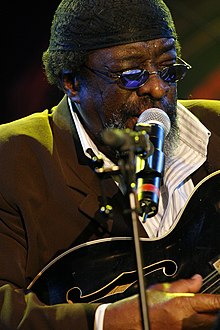
James "Blood" Ulmer (born February 2, 1942) is an American jazz and blues guitarist and singer. Ulmer's distinctive guitar sound has been described as "jagged" and "stinging." His singing has been called "raggedly soulful". Ulmer was born in St. Matthews, South Carolina. He began his career playing with various soul jazz ensembles, first in Pittsburgh, Pennsylvania, from 1959-1964, and then in the Columbus, Ohio region, from 1964-1967. He first recorded with organist John Patton in 1969. After moving to New York in 1971, Ulmer played with Art Blakey's Jazz Messengers, Joe Henderson, Paul Bley, Rashied Ali and Larry Young.
In the early 1970s, Ulmer joined Ornette Coleman; he was the first electric guitarist to record and tour extensively with Coleman. He has credited Coleman as a major influence, and Coleman's strong reliance on electric guitar in his fusion-oriented recordings owes a distinct debt to Ulmer.1983's Odyssey, with drummer Warren Benbow and violinist Charles Burnham, was described as "avant-gutbucket," leading writer Bill Milkowski to describe the music as "conjuring images of Skip James and Albert Ayler jamming on the Mississippi Delta."
Ulmer has recorded many albums as a leader, including three recent acclaimed blues-oriented records produced by Vernon Reid. He also performs solo.Ulmer was also a judge for the 8th annual Independent Music Awards to support independent artists.
In a 2005 Down Beat interview, Ulmer opined that guitar technique had not advanced since the death of Jimi Hendrix.[4] He stated that technique could advance "if the guitar would stop following the piano," and indicated that he tunes all of his guitar strings to "A". Fast forward to December 2006. James Blood Ulmer is gathered with "The Memphis Blood Blues Band" at Piety Street Studios in New Orleans. The seven-piece unit, who were named after the Grammy Award-nominated album Memphis Blood: The Sun Sessions which they recorded in 2001, features Vernon Reid on guitar, Charlie Burnham on fiddle, David Barnes on harmonica, Leon Gruenbaum on various keyboards, Mark Peterson on bass and Aubrey Dayle on drums. This is the third album they're recording together as a band and the follow-up to the critically-acclaimed No Escape From the Blues: The Electric Lady Sessions released in 2003. As a group, they're razor sharp from several tours of Europe over the past year.
Ulmer alternately growls out direction as to the songs' arrangements and shouts his encouragement as they take form. He possesses a singular vision for the music that's shaped by his childhood playing gospel in the Baptist church, his early 20's working the Midwest juke-joint circuit with artists like Hank Marr and his later years on the avant-jazz scene immersed in Ornette Coleman's harmolodic theory. Ironically, blues as a pre-determined style of music means little if anything to Ulmer. But the "concept of the blues" is a whole other thing entirely. A lyric from Ulmer's "There Is Power In The Blues" might best set the tone: "Let's put the color back in the blues, way down here in New Orleans, let's start over just one more time, use the concept of the blues to feel our way around."
In the early 1970s, Ulmer joined Ornette Coleman; he was the first electric guitarist to record and tour extensively with Coleman. He has credited Coleman as a major influence, and Coleman's strong reliance on electric guitar in his fusion-oriented recordings owes a distinct debt to Ulmer.1983's Odyssey, with drummer Warren Benbow and violinist Charles Burnham, was described as "avant-gutbucket," leading writer Bill Milkowski to describe the music as "conjuring images of Skip James and Albert Ayler jamming on the Mississippi Delta."
Ulmer has recorded many albums as a leader, including three recent acclaimed blues-oriented records produced by Vernon Reid. He also performs solo.Ulmer was also a judge for the 8th annual Independent Music Awards to support independent artists.
In a 2005 Down Beat interview, Ulmer opined that guitar technique had not advanced since the death of Jimi Hendrix.[4] He stated that technique could advance "if the guitar would stop following the piano," and indicated that he tunes all of his guitar strings to "A". Fast forward to December 2006. James Blood Ulmer is gathered with "The Memphis Blood Blues Band" at Piety Street Studios in New Orleans. The seven-piece unit, who were named after the Grammy Award-nominated album Memphis Blood: The Sun Sessions which they recorded in 2001, features Vernon Reid on guitar, Charlie Burnham on fiddle, David Barnes on harmonica, Leon Gruenbaum on various keyboards, Mark Peterson on bass and Aubrey Dayle on drums. This is the third album they're recording together as a band and the follow-up to the critically-acclaimed No Escape From the Blues: The Electric Lady Sessions released in 2003. As a group, they're razor sharp from several tours of Europe over the past year.
Ulmer alternately growls out direction as to the songs' arrangements and shouts his encouragement as they take form. He possesses a singular vision for the music that's shaped by his childhood playing gospel in the Baptist church, his early 20's working the Midwest juke-joint circuit with artists like Hank Marr and his later years on the avant-jazz scene immersed in Ornette Coleman's harmolodic theory. Ironically, blues as a pre-determined style of music means little if anything to Ulmer. But the "concept of the blues" is a whole other thing entirely. A lyric from Ulmer's "There Is Power In The Blues" might best set the tone: "Let's put the color back in the blues, way down here in New Orleans, let's start over just one more time, use the concept of the blues to feel our way around."
Wednesday, February 8, 2012
Friday, February 3, 2012
Bo Diddley - A Father of Rock and Roll
Ellas Otha Bates (December 30, 1928 – June 2, 2008), known by his stage name Bo Diddley, was an American rhythm and blues vocalist, guitarist, songwriter (usually as Ellas McDaniel), and inventor. He was also known as "The Originator" because of his key role in the transition from the blues to rock & roll, influencing a host of acts including Buddy Holly, Jimi Hendrix, The Rolling Stones, The Velvet Underground, The Who, The Clash, The Yardbirds, and Eric Clapton.He introduced more insistent, driving rhythms and a hard-edged guitar sound on a wide-ranging catalog of songs. Accordingly, he was inducted into the Rock and Roll Hall of Fame and received Lifetime Achievement Awards from the Rhythm and Blues Foundation and a Grammy Award from the National Academy of Recording Arts and Sciences. He was known in particular for his technical innovations, including his trademark rectangular guitar. Born in McComb, Mississippi, as Ellas Otha Bates,he was adopted and raised by his mother's cousin, Gussie McDaniel, whose surname he assumed, becoming Ellas McDaniel. In 1934, the McDaniel family moved to the largely black South Side area of Chicago, where the young man dropped the name Otha and became known as Ellas McDaniel, until his musical ambitions demanded that he take on a more catchy identity. In Chicago, he was an active member of his local Ebenezer Baptist Church, where he studied the trombone and the violin, becoming proficient enough on the latter for the musical director to invite him to join the orchestra, with which he performed until the age of 18. He was more impressed, however, by the pulsating, rhythmic music he heard at a local Pentecostal Church, as well as an interest in the guitar.Inspired by a concert where he saw John Lee Hooker perform,he supplemented his work as a carpenter and mechanic with a developing career playing on street corners with friends, including Jerome Green (c. 1934–1973),in a band called The Hipsters (later The Langley Avenue Jive Cats). During the summer of 1943–44, he played for tips at the Maxwell Street market in a band with Earl Hooker.[9] By 1951 he was playing on the street with backing from Roosevelt Jackson (on washtub bass) and Jody Williams (whom he had taught to play the guitar). Williams later played lead guitar on "Who Do You Love?" (1956).In 1951 he landed a regular spot at the 708 Club on Chicago's South Side, with a repertoire influenced by Louis Jordan, John Lee Hooker, and Muddy Waters.
In late 1954, he teamed up with harmonica player Billy Boy Arnold, drummer Clifton James, and bass player Roosevelt Jackson, and recorded demos of "I'm A Man" and "Bo Diddley". They re-recorded the songs at Chess Studios with a backing ensemble comprising Otis Spann (piano), Lester Davenport (harmonica), Frank Kirkland (drums), and Jerome Green (maracas). The record was released in March 1955, and the A-side, "Bo Diddley", became a #1 R&B hit.
McDaniel adopted the stage name "Bo Diddley".It originates from the a one-stringed instrument called the diddley bow. A "diddley bow" is a typically homemade American string instrument of African origin, probably developed from instruments found on the coast of west Africa. Bo Diddley was well known for the "Bo Diddley beat," a rumba-like beat similar to "hambone", a style used by street performers who play out the beat by slapping and patting their arms, legs, chest, and cheeks while chanting rhymes. Somewhat resembling "shave and a haircut, two bits" beat, Diddley came across it while trying to play Gene Autry's "(I've Got Spurs That) Jingle, Jangle, Jingle". Three years before Bo's "Bo Diddley", a song that closely resembles it, "Hambone", was cut by Red Saunders' Orchestra with The Hambone Kids.
In its simplest form, the Bo Diddley beat can be counted out as a two-bar phrase:His songs (for example, "Hey Bo Diddley" and "Who Do You Love?") often have no chord changes; that is, the musicians play the same chord throughout the piece, so that the rhythms create the excitement, rather than having the excitement generated by harmonic tension and release. In his other recordings, Bo Diddley used a variety of rhythms, from straight back beat to pop ballad style to doo-wop, frequently with maracas by Jerome Green.
Also an influential guitar player, he developed many special effects and other innovations in tone and attack. Bo Diddley's trademark instrument was the rectangular-bodied Gretsch nicknamed "The Twang Machine" (referred to as "cigar-box shaped" by music promoter Dick Clark). Although he had other similar-shaped guitars custom-made for him by other manufacturers, he fashioned this guitar himself around 1958 and wielded it in thousands of concerts over the years. In a 2005 interview on JJJ radio in Australia, Bo implied that the design sprang from an embarrassing moment. During an early gig, while jumping around on stage with a Gibson L5 guitar, he landed awkwardly hurting his groin. He then went about designing a smaller, less restrictive guitar that allowed him to keep jumping around on stage while still playing his guitar. He also played the violin, which is featured on his mournful instrumental "The Clock Strikes Twelve", a 12-bar blues.
On November 20, 1955, he appeared on The Ed Sullivan Show, a popular television variety show, where he infuriated the host. "I did two songs and he got mad," Bo Diddley later recalled. "Ed Sullivan said that I was one of the first colored boys to ever double-cross him. Said that I wouldn't last six months". The show had requested that he sing the Merle Travis-penned Tennessee Ernie Ford hit "Sixteen Tons", but when he appeared on stage, he sang "Bo Diddley" instead. This substitution resulted in his being banned from further appearances.The request came about because Sullivan's people heard Diddley casually singing "Sixteen Tons" in the dressing room. Before long, Diddley's distorted, amplified, custom-made guitar, with its rectangular shape and pumping rhythm style became a familiar, much-imitated trademark, as did his self-referential songs with such titles as "Bo Diddley's A Gunslinger", "Diddley Daddy" and "Bo's A Lumberjack". His jive-talking routine with "Say Man" (a US Top 20 hit in 1959) continued on "Pretty Thing" and "Hey Good Lookin'", which reached the lower regions of the UK charts in 1963. By then, Diddley was regarded as something of an R&B legend and found a new lease of life courtesy of the UK beat boom.
Over the decades, Bo Diddley's venues ranged from intimate clubs to stadiums. On March 25, 1972, he played with The Grateful Dead at the Academy of Music in New York City. The Grateful Dead released part of this concert as Volume 30 of the band's Dick's Picks concert album series. Also in the early 1970s, the soundtrack for the ground-breaking animated film Fritz The Cat contained his song "Bo Diddley", in which a crow idly finger-pops along to the track.
Bo Diddley spent many years in New Mexico, living in Los Lunas, New Mexico from 1971 to 1978 while continuing his musical career. He served for two and a half years as Deputy Sheriff in the Valencia County Citizens' Patrol; during that time he personally purchased and donated three highway patrol pursuit cars. In the late 1970s, Diddley left Los Lunas and moved to Hawthorne, Florida where he lived on a large estate in a custom made log-cabin home, which he helped to build. For the remainder of his life he spent time between Albuquerque, New Mexico and Florida, living the last 13 years of his life in Archer, Florida, a small farming town near Gainesville.
He appeared as an opening act for The Clash in their 1979 US tour; in Legends of Guitar (filmed live in Spain, 1991) with B.B. King, Les Paul, Albert Collins, George Benson, among others, and joined The Rolling Stones as a guest on their 1994 concert broadcast of Voodoo Lounge, performing "Who Do You Love?" with the band. Sheryl Crow and Robert Cray also appeared on the pay-per-view special.In 1998, Bo appeared alongside legendary guitarists B.B. King, Eric Clapton, and Jeff "Skunk" Baxter as members of the Louisiana Gator Boys in the film Blues Brothers 2000.
In 2003, Bo was cast as himself in an episode of According to Jim, titled Bo Diddley.
Bo Diddley died on June 2, 2008 of heart failure at his home in Archer, Florida.[24][25] Garry Mitchell, a grandson of Diddley and one of more than 35 family members at the musician's home when he died at 1:45 a.m. EDT (05:45 GMT), said his death was not unexpected. "There was a gospel song that was sung (at his bedside) and (when it was done) he said 'wow' with a thumbs up," Mitchell told Reuters, when asked to describe the scene at Diddley's deathbed. "The song was 'Walk Around Heaven' and in his last words he said 'I'm going to heaven".
In late 1954, he teamed up with harmonica player Billy Boy Arnold, drummer Clifton James, and bass player Roosevelt Jackson, and recorded demos of "I'm A Man" and "Bo Diddley". They re-recorded the songs at Chess Studios with a backing ensemble comprising Otis Spann (piano), Lester Davenport (harmonica), Frank Kirkland (drums), and Jerome Green (maracas). The record was released in March 1955, and the A-side, "Bo Diddley", became a #1 R&B hit.
McDaniel adopted the stage name "Bo Diddley".It originates from the a one-stringed instrument called the diddley bow. A "diddley bow" is a typically homemade American string instrument of African origin, probably developed from instruments found on the coast of west Africa. Bo Diddley was well known for the "Bo Diddley beat," a rumba-like beat similar to "hambone", a style used by street performers who play out the beat by slapping and patting their arms, legs, chest, and cheeks while chanting rhymes. Somewhat resembling "shave and a haircut, two bits" beat, Diddley came across it while trying to play Gene Autry's "(I've Got Spurs That) Jingle, Jangle, Jingle". Three years before Bo's "Bo Diddley", a song that closely resembles it, "Hambone", was cut by Red Saunders' Orchestra with The Hambone Kids.
In its simplest form, the Bo Diddley beat can be counted out as a two-bar phrase:His songs (for example, "Hey Bo Diddley" and "Who Do You Love?") often have no chord changes; that is, the musicians play the same chord throughout the piece, so that the rhythms create the excitement, rather than having the excitement generated by harmonic tension and release. In his other recordings, Bo Diddley used a variety of rhythms, from straight back beat to pop ballad style to doo-wop, frequently with maracas by Jerome Green.
Also an influential guitar player, he developed many special effects and other innovations in tone and attack. Bo Diddley's trademark instrument was the rectangular-bodied Gretsch nicknamed "The Twang Machine" (referred to as "cigar-box shaped" by music promoter Dick Clark). Although he had other similar-shaped guitars custom-made for him by other manufacturers, he fashioned this guitar himself around 1958 and wielded it in thousands of concerts over the years. In a 2005 interview on JJJ radio in Australia, Bo implied that the design sprang from an embarrassing moment. During an early gig, while jumping around on stage with a Gibson L5 guitar, he landed awkwardly hurting his groin. He then went about designing a smaller, less restrictive guitar that allowed him to keep jumping around on stage while still playing his guitar. He also played the violin, which is featured on his mournful instrumental "The Clock Strikes Twelve", a 12-bar blues.
On November 20, 1955, he appeared on The Ed Sullivan Show, a popular television variety show, where he infuriated the host. "I did two songs and he got mad," Bo Diddley later recalled. "Ed Sullivan said that I was one of the first colored boys to ever double-cross him. Said that I wouldn't last six months". The show had requested that he sing the Merle Travis-penned Tennessee Ernie Ford hit "Sixteen Tons", but when he appeared on stage, he sang "Bo Diddley" instead. This substitution resulted in his being banned from further appearances.The request came about because Sullivan's people heard Diddley casually singing "Sixteen Tons" in the dressing room. Before long, Diddley's distorted, amplified, custom-made guitar, with its rectangular shape and pumping rhythm style became a familiar, much-imitated trademark, as did his self-referential songs with such titles as "Bo Diddley's A Gunslinger", "Diddley Daddy" and "Bo's A Lumberjack". His jive-talking routine with "Say Man" (a US Top 20 hit in 1959) continued on "Pretty Thing" and "Hey Good Lookin'", which reached the lower regions of the UK charts in 1963. By then, Diddley was regarded as something of an R&B legend and found a new lease of life courtesy of the UK beat boom.
Over the decades, Bo Diddley's venues ranged from intimate clubs to stadiums. On March 25, 1972, he played with The Grateful Dead at the Academy of Music in New York City. The Grateful Dead released part of this concert as Volume 30 of the band's Dick's Picks concert album series. Also in the early 1970s, the soundtrack for the ground-breaking animated film Fritz The Cat contained his song "Bo Diddley", in which a crow idly finger-pops along to the track.
Bo Diddley spent many years in New Mexico, living in Los Lunas, New Mexico from 1971 to 1978 while continuing his musical career. He served for two and a half years as Deputy Sheriff in the Valencia County Citizens' Patrol; during that time he personally purchased and donated three highway patrol pursuit cars. In the late 1970s, Diddley left Los Lunas and moved to Hawthorne, Florida where he lived on a large estate in a custom made log-cabin home, which he helped to build. For the remainder of his life he spent time between Albuquerque, New Mexico and Florida, living the last 13 years of his life in Archer, Florida, a small farming town near Gainesville.
He appeared as an opening act for The Clash in their 1979 US tour; in Legends of Guitar (filmed live in Spain, 1991) with B.B. King, Les Paul, Albert Collins, George Benson, among others, and joined The Rolling Stones as a guest on their 1994 concert broadcast of Voodoo Lounge, performing "Who Do You Love?" with the band. Sheryl Crow and Robert Cray also appeared on the pay-per-view special.In 1998, Bo appeared alongside legendary guitarists B.B. King, Eric Clapton, and Jeff "Skunk" Baxter as members of the Louisiana Gator Boys in the film Blues Brothers 2000.
In 2003, Bo was cast as himself in an episode of According to Jim, titled Bo Diddley.
Bo Diddley died on June 2, 2008 of heart failure at his home in Archer, Florida.[24][25] Garry Mitchell, a grandson of Diddley and one of more than 35 family members at the musician's home when he died at 1:45 a.m. EDT (05:45 GMT), said his death was not unexpected. "There was a gospel song that was sung (at his bedside) and (when it was done) he said 'wow' with a thumbs up," Mitchell told Reuters, when asked to describe the scene at Diddley's deathbed. "The song was 'Walk Around Heaven' and in his last words he said 'I'm going to heaven".
Subscribe to:
Posts (Atom)


