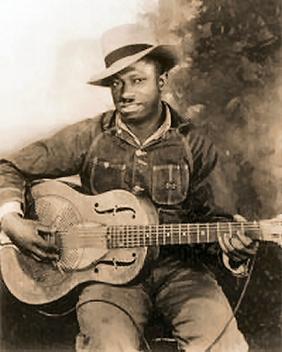
Robert Petway was an African-American blues singer and guitarist.
Very little is known about Robert Petway. His birthplace is speculated to have been at or near J.F. Sligh Farm near Yazoo City, Mississippi, birthplace of his close friend and fellow bluesman Tommy McClennan. His birthdate is guessed at 1908, and the date and even the occurrence of his death is unknown. There is only one known picture of Petway, a publicity photo from 1941. He only recorded 16 songs, but he is said to have been an influence on many notable blues and rock musicians, including John Lee Hooker, Muddy Waters, and Jimi Hendrix.Like many bluesmen from the Mississippi Delta, Petway traveled around as a musician, playing at parties, roadhouses, and other venues available. Petway and McClennan often travelled and performed together. After McClennan had been in Chicago for a few years, Petway travelled north to join him and cut records, as did Georgia's Frank Edwards who met them in MS.
One of Petway's most influential songs is "Catfish Blues", which he recorded in 1941. Muddy Waters used the lyrics and style of "Catfish Blues" for his first single "Rollin' Stone", the song from which the rock group The Rolling Stones chose their band name. There is debate on whether Petway deserves any credit for the Muddy Waters song, mostly stemming from the fact that blues musicians often borrow lines and verses from each other and often use common symbols and phrases that can't be traced back to one source. There is even some speculation that Tommy McClennan wrote the version that Petway recorded. Max Haymes has written a well-researched article, "Catfish Blues (Origins of a Blues)" on the topic, available at earlyblues.com. When David "Honeyboy" Edwards, a follower of Petway, was asked if Petway wrote the song, he replied, "He just made that song up and used to play it at them old country dances. He just made it up and kept it in his head."
There is no record, official or unofficial, of Petway's death. As such, he may still be alive, though he would be roughly 100 years old. The last record of his public life is a quote from Honeyboy Edwards: "nobody I know heard what become of him!
Slim Harpo (January 11, 1924 – January 31, 1970) was an American blues musician. He was known as a master of the blues harmonica and the name "Slim Harpo" was derived from "harp," the popular nickname for the harmonica in blues circles. Born James Moore in Lobdell, Louisiana, the eldest in an orphaned family, he worked as a longshoreman and building worker during the late 1930s and early 1940s. He began performing in Baton Rouge bars under the name Harmonica Slim and later accompanied his brother-in-law, Lightnin' Slim, both live and in the studio. Named Slim Harpo by producer J.D. "Jay" Miller, he started his own recording career in 1957. His solo debut was the Grammy Hall of Fame single "I'm a King Bee" backed with "I Got Love If You Want It." Harpo recorded under A&R man J.D. "Jay" Miller, in Crowley, Louisiana for Excello Records based in Nashville, Tennessee, and enjoyed a string of popular R&B singles, including Rock & Roll Hall of Fame inductee "Rainin' In My Heart" (1961) and the number one Billboard R&B hit "Baby Scratch My Back" (1966). On these recordings he was accompanied by the regular stable of Excello musicians, including Lazy Lester.
British rock bands like The Rolling Stones, The Pretty Things, The Yardbirds, Pink Floyd and Them featured versions of his songs in their early repertoires. Later, the riff from Harpo's 1966 hit "Shake Your Hips", which itself was derivative of Bo Diddley's "Bring It to Jerome," was used in the ZZ Top hit "La Grange" and the Rolling Stones covered the song on their 1972 album Exile On Main Street. Also, Th' Legendary Shack Shakers covered and released "Shake Your Hips" in 2003 on their album Cockadoodledon't.
Never a full-time musician, Harpo had his own trucking business during the 1960s.
He died following a heart attack at the age of 46, and was buried in Mulatto Bend Cemetery in Port Allen, Louisiana.
Robert Lee McCollum (November 30, 1909 – November 5, 1967[1]) was an American blues musician who played and recorded under the pseudonyms Robert Lee McCoy and Robert Nighthawk.
Born in Helena, Arkansas.By the time he was 15, young Robert had learned to play the harmonica from an obscure musician from Louisiana by the name of Johnny Jones. Robert soon felt confident enough playing the harp that he decided to leave home and took to the life of a busking musician. And, for the remainder of his life, he was ever on the move.
His early travels reportedly took him to Memphis, where it is reported that while still a teenager, he worked with Will Shade and the Memphis Jug Band. And, by 1930, he had apparently reached as far north as St. Louis, playing alongside pianist, Peetie Wheatstraw. This position earned the youngster the moniker Peetie's Boy.
Back home in the Delta, Robert's life took a significant turn when he met his distant cousin, Houston Stackhouse, that same year. A year younger than Robert, Stackhouse was a guitarist deeply influenced by the style of Tommy Johnson. In turn, he introduced Robert to the rudiments of playing guitar, and it wasn't very long afterwards that Robert soon surpassed Stackhouse on the instrument.
he left home at an early age to become a busking musician, and after a period wandering through southern Mississippi, settled for a time in Memphis, Tennessee where he played with local orchestras and musicians, such as the Memphis Jug Band. A particular influence during this period was Houston Stackhouse, from whom he learnt to play slide guitar, and with whom he appeared on the radio in Jackson, Mississippi.After further travels through Mississippi, he found it advisable to take his mother's name, and as Robert Lee McCoy moved to St. Louis, Missouri in the mid 1930s. Local musicians with whom he played included Henry Townsend, Big Joe Williams, and Sonny Boy Williamson. This led to two recording dates in 1937, the four musicians recording together at the Victor Records studio in Aurora, Illinois as well as recordings under his own name, including "Prowling Night-Hawk" (recorded 5 May 1937), from which he was take his later pseudonym.The electric guitar was a fairly new instrument in the late-1930s. Robert combined his new found fondness for playing slide with the amplified guitar and created an eerie sound that quickly caught the attention of several young musicians. Perhaps its greatest influence occurred when Robert returned to the Delta with this style. The haunting tone enamored a trio of players who took the electric slide to new heights and whose own fame surpassed that of Robert's. That trio was Earl Hooker, Elmore James and Muddy Waters.
These sessions led to Chicago blues careers for the other musicians, though not, however, for McCoy, who continued his rambling life, playing and recording (for Victor/Bluebird and Decca) solo and with various musicians, under various names. He also became a familiar voice on local radio stations; then Robert Lee McCoy disappeared.
Within a few years, he resurfaced as the electric slide guitarist Robert Nighthawk, and began recording for Aristocrat and Chess Records, the latter of which was also Muddy Waters' label; in 1949 and 1950, the two mens' styles were close enough that they were in competition for promotional activity; as Waters was the more marketable commodity, being more reliable and a more confident stage communicator, he received the attention. Though Nighthawk continued to perform and to record, taking up with United and States in 1951 and 1952, he failed to achieve great commercial success.
In 1963, Nighthawk was rediscovered busking in Chicago and this led to further recording sessions and club dates, and to his return to Arkansas, where he appeared on the King Biscuit Time radio programme on KFFA. As late as 1964, Nighthawk could be found playing on Chicago's, Maxwell Street. He had a stroke followed by a heart attack and died of heart failure at his home in Helena.
Houston Stackhouse never achieved much in the way of success, yet he was a pivotal figure on the Southern blues scene from the 1930s through the 1960s, having worked with numerous significant blues musicians during that period, mentoring more than a few. He was a familiar figure in the small country juke joints, mainly in Arkansas and Memphis, Tennessee, and was highly respected among his fellow musicians. He also achieved a measure of regional fame as a member of the King Biscuit Boys who played on station KFFA out of Helena, present-day Helena-West Helena (Phillips County). When he finally made his first recordings in 1967, he was still a working musician, taking jobs within a 150-mile radius of his home base in Helena.
Houston Stackhouse was born Houston Goff on September 28, 1910, the son of Garfield Goff from Wesson, Mississippi. He only learned of his parentage and name at birth in the 1970s while trying to obtain a passport. He was raised on the Randall Ford Plantation by James Wade Stackhouse. As a youngster, he heard music from fiddler Lace Powell, who lived on the plantation, and two visiting uncles. His musical education began when the family moved a few miles north to Crystal Springs around 1925 and encountered the brothers Tommy, Mager, and Clarence Johnson. In addition to learning from the Johnson brothers, he was inspired by local musicians, as well as the records of Blind Lemon Jefferson, Lonnie Johnson, and Blind Blake. He launched his own career in the mid-to-late 1930s playing all over Mississippi, Arkansas, and Louisiana and working with musicians such as the Chatmon brothers (who performed as the Mississippi Sheiks), Robert Johnson, Charlie McCoy, Walter Vinson, and others. His two most enduring partnerships from this period were with Carey “Ditty” Mason and his cousin Robert McCollum—better known as Robert Nighthawk, whom he taught how to play guitar.
In 1946, Nighthawk asked Stackhouse to join him in Helena, where Stackhouse stayed for almost twenty-five years. For a year, he was a member of Nighthawk’s band, playing throughout Arkansas and Mississippi and on KFFA radio promoting Mother’s Best Flour. After splitting with Nighthawk in 1947, he joined with drummer James “Peck” Curtis, who was working on KFFA’s King Biscuit Time alongside guitarist Joe Willie Wilkins and pianists Robert Traylor and Pinetop Perkins. In 1948, Sonny Boy Williamson rejoined the show, and the group performed all over the Delta, using radio spots to promote their appearances. Stackhouse played with all the important musicians who passed through Helena, including Jimmy Rogers, and Sammy Lawhorn, both of whom he tutored on guitar, as well as Elmore James, Earl Hooker, Willie Love, Ernest Lane, and Roosevelt Sykes. While he was an active blues musician at night, he worked days at the Chrysler plant in West Memphis (Crittenden County) between 1948 and 1954.
Unlike many of his fellow bluesmen, Stackhouse remained in the South, continuing to perform locally as well as working regular jobs through the 1950s. He continued to play with notable musicians through the 1960s, including Boyd Gilmore, Houston Boines, Frank Frost, and Baby Face Turner. In 1965, Sonny Boy Williamson returned to Helena and enlisted Stackhouse to join him once again on King Biscuit Time. That May, the group was recorded live by Chris Strachwitz of Arhoolie Records, a recording subsequently released under Williamson’s name as King Biscuit Time. Williamson died shortly after that recording, and Stackhouse continued briefly on the program with former partner Robert Nighthawk.
In 1967, field researcher George Mitchell recorded Stackhouse in Dundee, Mississippi. The group, calling themselves the Blues Rhythm Boys, consisted of “Peck” Curtis and Nighthawk. These were the final recordings of Nighthawk, who died a few months later. A week later, field researcher David Evans recorded Stackhouse in Crystal Springs with longtime partner Carey “Ditty” Mason. With the death of Mason in 1969 and Curtis the following year, Stackhouse moved to Memphis in 1970, where he lived with Joe Willie Wilkins and Wilkins’s wife, Carrie. He began taking part in the blues revival, touring with Wilkins throughout the decade as the King Biscuit Boys, traveling with the Memphis Blues Caravan, playing various festivals, and making a lone trip overseas to Vienna, Austria, in 1976. He recorded for Adelphi in 1972, with various live tracks appearing on compilations. Outside of playing the first two Delta Blues Festivals in Greenville, Mississippi, he largely retired from music after his European tour and moved to Crystal Springs.
Stackhouse returned to Helena, where he died on September 23, 1980, at the Helena Hospital, having outlived most of his peers. A son, Houston Stackhouse Jr., survived him.
If, indeed, the South will rise again, let it be musically and in the spirit of this biracial Ol’ Miss blues duo (born and raised in Mississippi and Missouri, respectively). Now based inf Mississippi, the Juke Joint Duo consists of drummer/vocalist Cedric Burnside, grandson of the late, great R.L Burnside, and guitarist Lightnin’ Malcolm. On their accurately titled album 2 Man Wrecking Crew (Delta Groove), it’s clear what makes this band so magnificent: They’ve managed to take traditional blues genres (hill-country, blue-moon, juke-joint, gut-bucket) and make it funky and refreshing without taking anything away from the music’s gritty roots. Audiences lucky enough to witness the band live will get a taste of the rhythmic and powerful sounds of classic Southern blues, then get hit with a punch of funk, a kick of hip-hop, and a whole lotta soul. The sound comes together perfectly, served in a grooving gumbo that hits you like a Mack truck. Lightnin’ and Burnside will be playing at the Lafayette Tap Room on Wednesday (Feb. 10). —jeremy lee
Robert Cage was born in New Orleans on April 4th 1937. A year later, his family moved to Natchez and from there to Woodville, Mississippi, a small woodsy town forgotten by time (evenby Mississippi standards). Robert's father owned a grocery store and it was there, on the porch, where Robert heard Scott Dunbar play and sing, as well as another performer named Pig. Robert's first guitar was a gift from his mother; it was new, from Sears and Roebuck, and had pictures of red cowboys on a white body. When Robert heard the electric sounds of John Lee Hooker, Muddy Waters, and Howlin' Wolf, he lost interest in Scott Dunbar's pre-war style. Robert wanted to catch up to the rest of America.
In 1958 Robert was in the house band at the State Line Club (Mississippi and Louisiana) and stayed loyal until it burned down, giving him little choice but to sign on at the Black Cat Club. In hope of earning more money, Robert went modern; he tightened up the same band, named them the Impalas, hired a saxophonist and added Sam Cooke and Chuck Berry numbers to their set lists. But the Impalas just weren't meant to be-- no matter what they added to their routine, or how many long, hard tours they made through Mississippi and Louisiana. Robert Cage weighed almost 200 pounds when he started the Impalas and at quitting time weighed in at less than 100. Thank you very much, whiskey.
In 1970 Robert married Minnie and began full-time work as a diesel mechanic. Robert continued gigging at local parties with an occasional club date. It was the constant hassle of finding good bands that turned Robert into a solo performer and back to the style he first learned, Scott Dunbar's style, the way he plays today. Robert, became a Fat Possum Records Artist in the late nineties, along with T-Model Ford,Paul Wine Jones and Cedell Davis.
Born 1956, in Clarksville,Texas. Raised in Red River county, Texas, deep in the country of
northeast Texas. Early musical influences included the Memphis/Stax recording artists such
as Albert King, Wilson Pickett,Slim Harpo and Sam & Dave heard late at night on WLAC,Nashville,Tenn. A
guitar lesson with a travelin bluesman (believed to be ELMORE JAMES) passing thru DeKalb,
Texas(old stompin' grounds of LEADBELLY) at age 7 hooked him into the blues. Received first guitar at age 8, but wasn't very good at it. After finishing high school, joined
the U. S. Navy in 1975 & enlisted in the submarine service. After receiving christian conversion in 1980, suddenly received ability to play & compose blues & spirituals on guitar & harmonica (my father's instrument). Relocated to Cleveland, Ohio after leaving
the U. S. Navy in 1981 & begin performing part time for local gospel choirs, quartets & groups. Also played solo blues & gospel gigs. Became a ordained minister in the Holiness Church in 1995. Formed a Delta blues band, K. M. Williams & the Blues Train, in 1997. Gigs
included opening for ROBERT JR.LOCKWOOD,LITTLE MILTON,THE HOLMES BROTHERS & THE FIVE BLIND BOYS OF ALABAMA. Released one local cassette "Rollin'&Tumblin".
Relocated back to Texas (Dallas) in 1999.Begin performing solo blues gigs around Deep Ellum, Lower Greenville, Irving,& Arlington.Currently have released twenty-one internationally acclaimed CD's including 17 solo CD's starting with "THE REVEREND OF TEXAS COUNTRY BLUES(2000)";"TEXAS COUNTRY BLUES PREACHER(2001)";"SANCTIFED BOOGIE(2001)";"THE RETURN OF BROTHER LEMON(2002)(with Washboard Jackson on Percussion)",A dedication to BLIND WILLIE JOHNSON entitled"BLIND WILLIE'S HYMNS(2002)""I'M AN OLD SOUL(2003),"THE MINISTER OF TEXAS BOOGIE(2004)","COUNTRY ROADS,STREET CORNERS & CHURCH HOUSES"(2004),his first Label produced CD "THE BEST OF THE TEXAS COUNTRY BLUES PREACHER"(DWM MUSIC COMPANY - 2005),"TRUTH MUSIC"(2005),"THE RESURRECTION of BLIND WILLIE and OLD TIME SPIRITUALS"(2006),"HERE COMES THE PREACHER MAN"(2006),"LIVE WRECKAGE AND CLASSICS"(2007)(w Washboard Jackson),"THE LOST TAPES OF JUKES AND SPIRITUALS"(2007),"OLD SOUL/MINISTER OF TEXAS BOOGIE-REMASTERED,Snocap downloads only(2007)","LIVE AT THE LONGHORN BBQ"(2007)MORE WRECKAGE and CRIES FROM THE SOUL(2008).Also Formed a Rockin' Boogie/Blues duo with Texas Washboard Player and Percussionist WASHBOARD JACKSON called "TRAINRECK" and have since released four critically acclaimed CD's"THERE'S A TRAINRECK COMIN'(2003),"THE TRAIN KEEPS A'ROLLIN'(2004),"LIVE AT THE SCENE"(2005) and "11:59"(2006).Also have opened for or played on the same bill as KIM WILSON,WC CLARK,GARY CLARK JR.,ANDREW "JUNIOR BOY" JONES,ALVIN "YOUNGBLOOD" HART,ROBERT BELFOUR,RICHARD JOHNSTON,CEDELL DAVIS,DAVID "HONEYBOY" EDWARDS,JAMES MATHUS,and THE LEGENDARY MAVIS STAPLES. Two Documentaries was filmed on KM Williams & Trainreck;the first entitled"SANCTIFIED BOOGIE"(2004)based on the life of KM Williams which is currently available from Level Ground Films Productions & "A NITE IN A TRAINRECK"(2005)based on a typical night of performances following TRAINRECK(KM Williams & Washboard Jackson).Also released Music DVD'S entitled "KM WILLIAMS ;"LIVE AT THE LONGHORN BBQ"(DVD/2005)","LIVE IN ITALY(DVD/CD/2005) & "KM WILLIAMS & FRIENDS,LIVE IN SWITZERLAND"(2006)which are live performances.. As of the present,continues to Preach(started the SOUND GOSPEL BIBLE MINISTRIES in 2002),Sing & Play the Gospel and The Texas Country Blues/Boogie to anyone willing to listen, anywhere and anytime! Signed to Dialtone Records in Austin, TX on May 17th,2010.